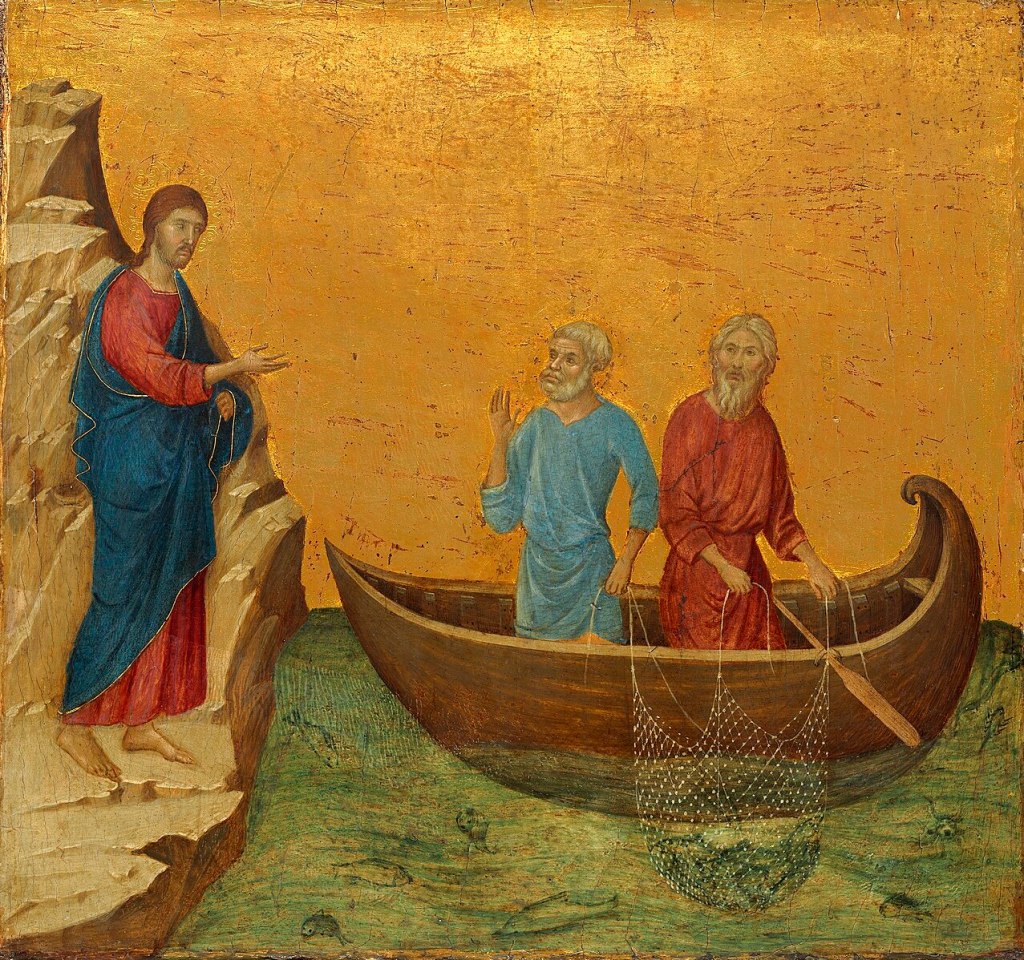
(art: Duccio di Buoninsegna, 1255–1319)
Today marks the 5th anniversary of the Vatican’s historic encyclical concerning forgiveness and reconciliation in societal relationships, Fratelli Tutti. The work was composed by Pope Francis, who quoted St. Francis of Assisi in opening the work with the words, “fratelli tutti,” meaning “all brothers and sisters.” The publication date of October 4th coincides with the date for the Memorial of St. Francis of Assisi. It is one of the principal contemporary works in and from the Catholic Church that one can read for a deeper understanding of forgiveness and reconciliation at the societal level.
For today, I want to share just some of the shortest memorable quotes from Fratelli Tutti:
- Truth should not lead to revenge, but rather to reconciliation and forgiveness.
- Forgiveness does not entail allowing oppressors to keep trampling on their own dignity and that of others, or letting criminals continue their wrongdoing.
- If a criminal has harmed me or a loved one, no one can forbid me from demanding justice and ensuring that this person – or anyone else – will not harm me, or others, again. This is entirely just; forgiveness does not forbid it but actually demands it.
- Each of us should realize that “even the harsh judgment I hold in my heart against my brother or my sister, the open wound that was never cured, the offense that was never forgiven, the rancour that is only going to hurt me, are all instances of a struggle that I carry within me, a little flame deep in my heart that needs to be extinguished before it turns into a great blaze”.
- Forgiving does not mean forgetting.
- In the face of a reality that can in no way be denied, relativized or concealed, forgiveness is still possible.
- In the face of an action that can never be tolerated, justified or excused, we can still forgive.
- In the face of something that cannot be forgotten for any reason, we can still forgive.
- Free and heartfelt forgiveness is something noble, a reflection of God’s own infinite ability to forgive.
- If forgiveness is gratuitous, then it can be shown even to someone who resists repentance and is unable to beg pardon.
- Those who truly forgive do not forget. Instead, they choose not to yield to the same destructive force that caused them so much suffering. They break the vicious circle; they halt the advance of the forces of destruction.
- Forgiveness is precisely what enables us to pursue justice without falling into a spiral of revenge or the injustice of forgetting.
- If the music of the Gospel ceases to resonate in our very being, we will lose the joy born of compassion, the tender love born of trust, the capacity for reconciliation that has its source in our knowledge that we have been forgiven and sent forth.
- To be sure, “it is no easy task to overcome the bitter legacy of injustices, hostility and mistrust left by conflict. It can only be done by overcoming evil with good (cf. Rom 12:21) and by cultivating those virtues which foster reconciliation, solidarity and peace”.
- “Persons who nourish goodness in their heart find that such goodness leads to a peaceful conscience and to profound joy, even in the midst of difficulties and misunderstandings. Even when affronted, goodness is never weak but rather, shows its strength by refusing to take revenge”.
- Authentic reconciliation does not flee from conflict, but is achieved in conflict, resolving it through dialogue and open, honest and patient negotiation.
- In imitation of Mary, the Mother of Jesus, “we want to be a Church that serves, that leaves home and goes forth from its places of worship, goes forth from its sacristies, in order to accompany life, to sustain hope, to be the sign of unity… to build bridges, to break down walls, to sow seeds of reconciliation”.
- Reparation and reconciliation will give us new life and set us all free from fear.
In all the current conflicts around the world, perhaps most notably now in Ukraine and Palestine, the wisdom and possibilities for forgiveness and reconciliation explained in Fratelli Tutti still hold true, and may never have been needed as much before as they are now.
This text is an original work of its author Tom Delaney and was entirely composed without the use of artificial intelligence (AI).
If your parish or faith community is seeking a deeper experience of forgiveness, healing, mercy, and spiritual renewal, Live and Forgive is here to help. To begin the conversation, email Live and Forgive presenter and facilitator Tom Delaney at tom@liveandforgive.com — he will be glad to connect with you for a conversation. Please type in your email and click “Subscribe” below to stay connected and get Live and Forgive articles delivered to you.
Take your learning deeper! Enter the term or word for any idea or thing you saw in this article that you want to know more about, and you will get a list of other articles that also talk about that idea or thing!
 Live and Forgive