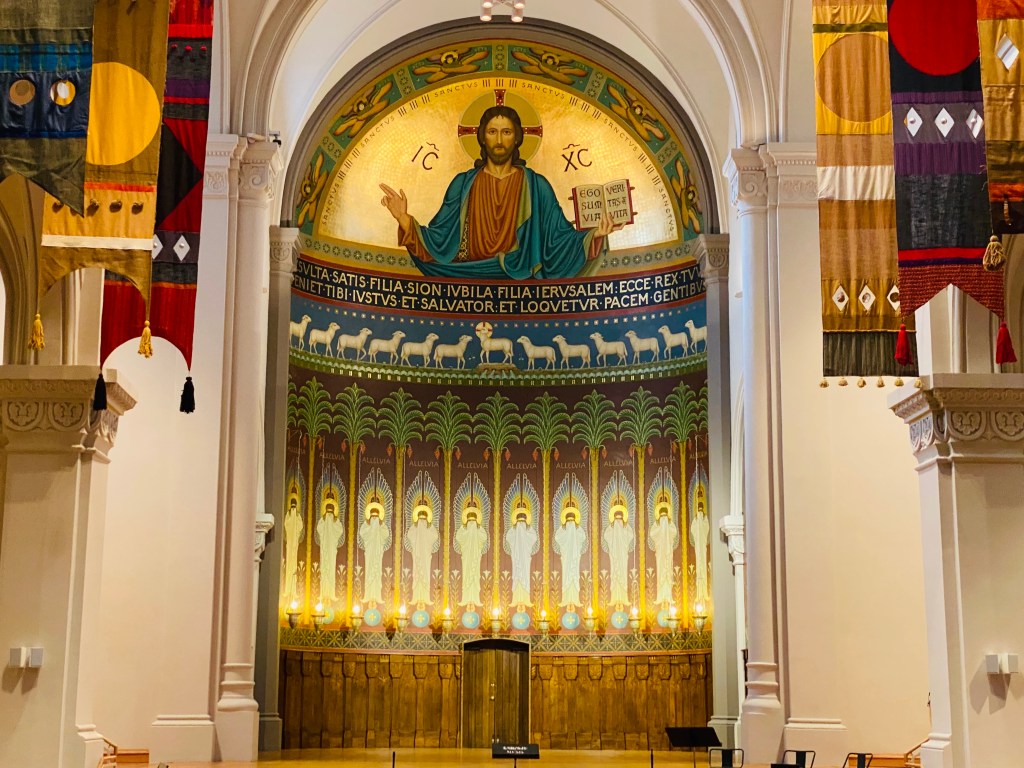
(photo: St. John’s Abbey & University, Tom Delaney, 2025)
“Praised be you, my Lord, through those who forgive for your love…blessed are those who endure in peace, for by you, Most High, they will be crowned.” ~ St. Francis of Assisi
Are wellness and forgiveness important values in your parish or community?
Does your parish or community want the skills and resources for wellness and forgiveness to grow in Catholic faith?
Could your parish or community benefit from a no-cost presentation, guided retreat, or facilitated small group series focusing on wellness or forgiveness?
Catholic Wellness & Forgiveness Education
Live and Forgive is a wellness and forgiveness education project to support the Church’s mission of forming disciples who live the Gospel through mercy, compassion, and restored relationships. Rooted in Catholic theology and the spiritual wisdom of the early Christian monastic and Franciscan traditions, Live and Forgive is an educational resource that offers retreats and small-group sessions that help individuals and parish communities grow in practices of wellness and interpersonal forgiveness. These gatherings are educational programs — opportunities for learning, prayer, and spiritual growth shaped by the teachings of the Church. The mission of Live and Forgive is to partner with parish leaders in fostering communities where wellness and forgiveness are lived daily—strengthening families, renewing parish life, and helping people experience the freedom that comes from a heart open to God’s grace.
Wellness & Forgiveness Education for Real Life
Live and Forgive learning events use resources from the Human Flourishing Program at Harvard University combined with Sacred Scripture, the Catechism of the Catholic Church, and the spiritual wisdom of the early Christian monastic and Franciscan traditions, to answer the questions Catholic parish and community members have about wellness and forgiveness:
- What are wellness and forgiveness? Are there different kinds of wellness and forgiveness?
- What does Sacred Scripture and the Catechism of the Catholic Church say about wellness and forgiveness?
- Why are wellness and forgiveness important? For Catholic faith? For living my best life?
- What are the physical, mental and spiritual benefits of learning practices for better wellness, including forgiveness?
- Can I learn how to be well? Can I learn how to have well-being?
- Can I learn how to forgive? Can I learn to be a forgiving person?
- What do I need to learn and practice in order to have wellness?
- What do I need to learn and practice in order to forgive?
- What is the best way to learn practices of wellness and of forgiveness?
- How can I help people in my family, friendships, and workplace, to improve their wellness and be more forgiving?
Live and Forgive learning events answer these questions in ways that are easy to understand, and easy to apply in real life. People want to learn about wellness and forgiveness in a way that will make a difference in their lives, and that’s what a Live and Forgive learning event will do for your parish or community.
Wellness & Forgiveness Education that Transforms
Wellness and forgiveness education is more than just teaching and thinking about wellness and forgiveness. Researchers in wellness and forgiveness explain that learning and “doing” wellness and forgiveness activates our to acquire and exercise virtue, make moral decisions, and take moral actions.1,2,3 When we are using our moral agency we engage in virtuous moral behaviors like kindness, respect, and generosity. But moral agency goes deeper than just the things we do. In moral agency we also engage with deeper understandings of our own life experiences, including our beliefs, desires, and goals.
Learning and engaging with practices of wellness and interpersonal forgiveness provides people with the relief from emotional, mental, and physical suffering noted with consistency in research.4,5,6,7 But just as importantly, wellness and forgiveness education transforms people in ways that activate not only personal beliefs and self-understanding, but that can transform an entire parish or community. Wellness and forgiveness education offers an effective way to promote wellness, inner renewal, and spiritual growth for members of your parish or other Catholic community — and that’s exactly what Live and Forgive offers.
What makes Live and Forgive work is that it recognizes that our beliefs and self-understanding as Catholics are based on Sacred Scripture and the Catechism of the Catholic Church, along with Church tradition, participation in the Sacraments, and other ways that the Catholic Church provides each of us with illumination and inspiration for our lives. Live and Forgive builds on these sources of guidance and inspiration in our lives to design and deliver forgiveness education that is both aligned to Catholic values and is truly transformative for people and their communities.
Here to Help: Secular Franciscan, Theologian & Educator
As a Live and Forgive presenter and facilitator, I bring your parish or community my 30+ years of experience as an educational psychologist designing and delivering high-quality learning events for diverse audiences, including students, families, educators, caregivers, and community leaders. I also bring to you my 20+ years as a socially engaged theologian building communities for human flourishing, with my foundation in Catholic spirituality and catechesis. I am a Secular Franciscan with a commitment to being a bearer of peace working with the transforming power of love and pardon (Rule of the Secular Franciscan Order).8 By working with your parish or community, you are giving me the gift of work, and a share in the creation and redemption of, as well as service to, the human community.9 From a Franciscan perspective, creation, redemption, service and the human community are important parts of what is called “human flourishing,” and forgiveness has a crucial role in it.
Forgiveness and Flourishing: The Franciscan Perspective
Live and Forgive learning events are grounded in the Franciscan perspective of human flourishing, and especially interpersonal forgiveness. The Franciscan perspective on human flourishing is the essential component in the design of a Live and Forgive learning event. It’s the beating heart of the event, and the “non-negotiable” in the best way. Fr. Caoimhín Ó Laoide (OFM) provides a very good explanation of the Franciscan perspectives of human flourishing and will help you understand what Live and Forgive is about.
Contemporary scientific research is validating what we have known in the Catholic Church for a very long time: faith communities are important for promotion of human flourishing and the common good.10,11 Interpersonal forgiveness and reconciliation are an essential components of human flourishing and the establishment of the “civilization of love” explained by Pope St. John Paul II.12,13,14 Live and Forgive helps your parish or community intentionally step into the role of promoting human flourishing by providing members of your parish or community with practical instruction for interpersonal forgiveness and reconciliation that also integrates the Franciscan perspective of human flourishing.
Wellness and Forgiveness Are Teachable
Live and Forgive learning events operate with the principle that wellness and forgiveness can be taught. Specifically as practices, wellness and forgiveness are something that a person can:
- Learn to do with its essential components and steps.
- Apply in life situations to get desired results.
- Improve at over time with experience.
- Transform their values, predispositions, and self-identity with to “be well” and become “a forgiving person.”
You can compare the practices of wellbeing and forgiveness to any other thing that people “put into practice” in their life. For example, any practice of wellbeing and forgiveness can be compared to learning to play a musical instrument. At first, you look at the instrument and have at best only a rough idea of where to begin, so you take some lessons. Soon you find yourself learning and playing the instrument — able to play it when you want to do so. Very quickly you observe yourself improving each week and able to play pieces that are more challenging. Stick with it long enough and you can gain enough ability to justifiably know yourself by the term “musician.” Stick with the practices of wellness and interpersonal forgiveness long enough and you can gain enough ability to justifiably know yourself as a “person with wellness” or “forgiving person”. That’s how practices work: learning that changes a person over time and makes them better and better at something important.
The REACH Forgiveness Model & Process
Live and Forgive uses the REACH Forgiveness Model and Process. It is the scientifically validated practice of interpersonal (person-to-person) forgiveness and interpersonal reconciliation that I am trained in by the Human Flourishing Program at Harvard University.15,16,17,18 This model and process is intentionally designed to be very practical and something that an ordinary person can understand and use. Importantly, it is a clearly defined way for people to enact interpersonal forgiveness and reconciliation. Interpersonal forgiveness and reconciliation is encouraged in Sacred Scripture and the Catechism of the Catholic Church, as well as Franciscan tradition and spirituality.19,20,21
The REACH Forgiveness Model & Process consists of five essential components and steps:22
- R is for “recall”—remembering the hurt that was done to you as objectively as you can.
- E is for “empathize”—trying to understand the viewpoint of the person who wronged you.
- A is for the “altruism”—thinking about a time you hurt someone and were forgiven, then offering the gift of forgiveness to the person who hurt you.
- C is for “committing”—publicly forgiving the person who wronged you.
- H is for “holding on”—not forgetting the hurt, but reminding yourself that you made the choice to forgive.
Whether and how your parish engages with the REACH Forgiveness Model and Process is up to you. The five basic components and steps can be simply shared as part of an informative presentation. In a half- or full-day retreat or small group series, participants can have a guided experience of each of the components and steps. A workbook for a personal experience of the REACH steps and process is available to Live and Forgive learning event participants at no cost to them, and at no cost to your parish or community.23
Live and Forgive events are creative collaborations!
Live and Forgive learning events are not pre-packaged “take it or leave it” deals. Designing a Live and Forgive learning event involves me in collaborating with a coordinator or team in your parish or community (e.g. mental health ministry coordinator) to plan an event based on what will work best for your parish or community. Your parish or community staff are the experts in what your parish or community needs and stay in the driver’s seat during the planning phase. My job is to support your planning process by offering the resources you can use to ensure an outstanding learning event about interpersonal forgiveness and reconciliation. If it works best for you, your parish or community coordinator or team can even be part of delivering the learning event as a co-presenter(s) or co-facilitator(s).
You choose the learning format!
Your parish or community coordinator or team and I collaborate to plan the format for the learning event that will work best for your parish or community. The possibilities include, but are not limited to:
- Onsite Presentation
- Virtual Presentation
- Onsite Guided Retreat (Day, Half-Day)
- Virtual Guided Retreat (Day, Half-Day)
- Onsite Small Group Series
- Virtual Small Group Series
- Onsite Wilderness Walk (Day, Half-Day)
It’s also possible for a Live and Forgive learning event format to be something very unique and creative.
No fees, no costs!
Live and Forgive events are co-designed and co-facilitated at no cost to your parish or community. There are no fees, expense reimbursements, or other costs involved, including for instructional materials like the REACH Workbook from the Human Flourishing Program at Harvard University available through Live and Forgive. “Without cost you have received; without cost you are to give” (Matthew 10:8) — that’s how this works!
Let’s visit and talk about possibilities!
Interested in finding out more? Contact me with an email to tom@liveandforgive.com so that we can visit, talk about your parish or community, and think about possibilities. I respect your effort in serving your parish or community and would enthusiastically value the chance to talk with you about how it’s going, what you may be looking to do next especially in connection with forgiveness, and see if we can come up with some good ideas. If it would be helpful for me to pick up a coffee on my way over, just let me know — I do that too! Let’s visit!
Notes
- Wong, L. Y. (2024). Maximize the Impacts of Forgiveness Education with Moral Agency Development. Education Sciences, 14(12), 1346. https://doi.org/10.3390/educsci14121346: https://www.mdpi.com/2227-7102/14/12/1346.
- VanderWeele, T. J. (2022). The science of human flourishing. In J. R. Peteet (Ed.), The virtues in psychiatric practice (pp. 18). Oxford University Press.
- VanderWeele, T. J. (2024). A theology of health: Wholeness and human flourishing. University of Notre Dame Press
- Salamon, M. (2024, March 1). Not just good for the soul: Science is pinpointing how forgiveness also benefits our brains and bodies. Harvard Health Publishing: https://www.health.harvard.edu/mind-and-mood/not-just-good-for-the-soul.
- VanderWeele TJ. Is Forgiveness a Public Health Issue? Am J Public Health. 2018 Feb;108(2):189-190. doi: 10.2105/AJPH.2017.304210. PMID: 29320296; PMCID: PMC5846597: https://pmc.ncbi.nlm.nih.gov/articles/PMC5846597/.
- The Human Flourishing Program. (n.d.). How to flourish: Practical activities supported by scientific research. Harvard University. https://hfh.fas.harvard.edu/how-to-flourish
- VanderWeele, T.J. (2020). Activities for flourishing: an evidence-based guide. Journal of Positive Psychology and Wellbeing, 4:79-91.
- “Mindful that they are bearers of peace which must be built up unceasingly, they should seek out ways of unity and fraternal harmony through dialogue, trusting in the presence of the divine seed in everyone and in the transforming power of love and pardon.” Secular Franciscan Order. (1978). Rule of the Secular Franciscan Order.
https://ciofs.info/wp-content/uploads/2019/10/Rule-ENG.pdf. - “Let them esteem work both as a gift and as a sharing in the creation, redemption, and service of the human community.” Secular Franciscan Order. (1978). Rule of the Secular Franciscan Order.
https://ciofs.info/wp-content/uploads/2019/10/Rule-ENG.pdf. - Long, K. N., Nakamura, J. S., Long, P. M., Gregg, R. J., Abraham, F., Counted, V., & VanderWeele, T. (2025). Flourishing communities: The role of faith communities in the promotion of flourishing and the common good: https://dash.harvard.edu/server/api/core/bitstreams/d5deef4c-dbf3-4984-b6ee-1d5e42abe655/content.
- VanderWeele, T. J., & Lee, M. T. (2025). Love and human flourishing. International Journal of Wellbeing, 15(4): https://www.internationaljournalofwellbeing.org/index.php/ijow/article/view/4663.
- Cowden, R. G., Worthington Jr, E. L., Chung, C. A., & Chen, Z. J. (2025, April). Differential Effects of Decisional and Emotional Forgiveness on Psychological, Spiritual, Social, Volitional, and Physical Well-Being: A Scoping Review. In Healthcare (Vol. 13, No. 9, p. 992). MDPI: https://pmc.ncbi.nlm.nih.gov/articles/PMC12071234/pdf/healthcare-13-00992.pdf.
- Toussaint, L. (2022). Forgiveness and flourishing: Research and education. Spiritual Care, 11(4), 313-320: https://www.degruyterbrill.com/document/doi/10.1515/spircare-2022-0042/html.
- VanderWeele, T. J., & Lee, M. T. (2025). Love and human flourishing. International Journal of Wellbeing, 15(4): https://www.internationaljournalofwellbeing.org/index.php/ijow/article/view/4663.
- Harvard Health Publishing. (2021, February 12). The power of forgiveness. https://www.health.harvard.edu/mind-and-mood/the-power-of-forgiveness
- Ho MY, Worthington EL, Cowden RG, Bechara AO, Chen ZJ, Gunatirin EY, Joynt S, Khalanskyi VV, Korzhov H, Kurniati NMT, Rodriguez N, Anastasiya Salnykova A, Shtanko L, Tymchenko S, Voytenko VL, Zulkaida A, Mathur MB, VanderWeele TJ. International REACH forgiveness intervention: a multisite randomised controlled trial. BMJ Public Health. 2024 Mar 13;2(1):e000072. doi: 10.1136/bmjph-2023-000072. PMID: 40018096; PMCID: PMC11812785: https://bmjpublichealth.bmj.com/content/bmjph/2/1/e000072.full.pdf.
- Worthington EL. REACH Forgiveness: A Narrative Analysis of Group Effectiveness. Int J Group Psychother. 2024 Jul;74(3):330-364. doi: 10.1080/00207284.2024.2340593. Epub 2024 Apr 26. PMID: 38668727: https://www.tandfonline.com/doi/full/10.1080/00207284.2024.2340593.
- Molinero, C., Bonete, S., Crespí, P., Sendra Ramos, S., & González De Abreu, A. M. (2024). Effectiveness of forgiveness training programs in university contexts: a systematic review and meta-analysis. Cogent Education, 11(1). https://doi.org/10.1080/2331186X.2024.2378242: https://www.tandfonline.com/doi/full/10.1080/2331186X.2024.2378242.
- See Mark 11:25, Matthew 6:12, Matthew 6:14-15, Matthew 18:21-35, Luke 6:37, Luke 17:3-4, Luke 23:33-34, Ephesians 4:32, Colossians 3:13, and James 5:14-15.
- Mercy is a fruit of charity (para. 1829). Forgiving is a charitable action and spiritual act of mercy (para. 2447). Charity is a theological virtue (paras. 1822-1829). Catholic Church. (1997). Catechism of the Catholic Church (2nd ed.). Libreria Editrice Vaticana: https://www.usccb.org/catechism-of-the-catholic-church.
- “Praised be You, my Lord, through those who give pardon for Your love,” St. Francis of Assisi, Canticle of the Creatures, v. 12, and “Francis was always a man of peace and reconciliation, quick to pardon, slow to anger,” St. Bonaventure, Life of St. Francis, Chapter 8, §5.
- Worthington, E. L., Jr. (2020). An update of the REACH Forgiveness model: Psychoeducation in groups, do-it-yourself formats, couple enrichment, religious congregations, and as an adjunct to psychotherapy. In E. L. Worthington, Jr. & N. G. Wade (Eds.), Handbook of forgiveness (2nd ed., pp. 277–287). Routledge/Taylor & Francis Group. https://doi.org/10.4324/9781351123341-26.
- Harvard Human Flourishing Program. (2025). Your path to REACH forgiveness: Workbook (adapted for churches). https://hfh.fas.harvard.edu/sites/g/files/omnuum8886/files/2025-04/HFH_REACH%20WB%20for%20Churches_Digital_1-Page_Spreads_Final_April_28_2025_136_Pages_0.pdf.
 Live and Forgive