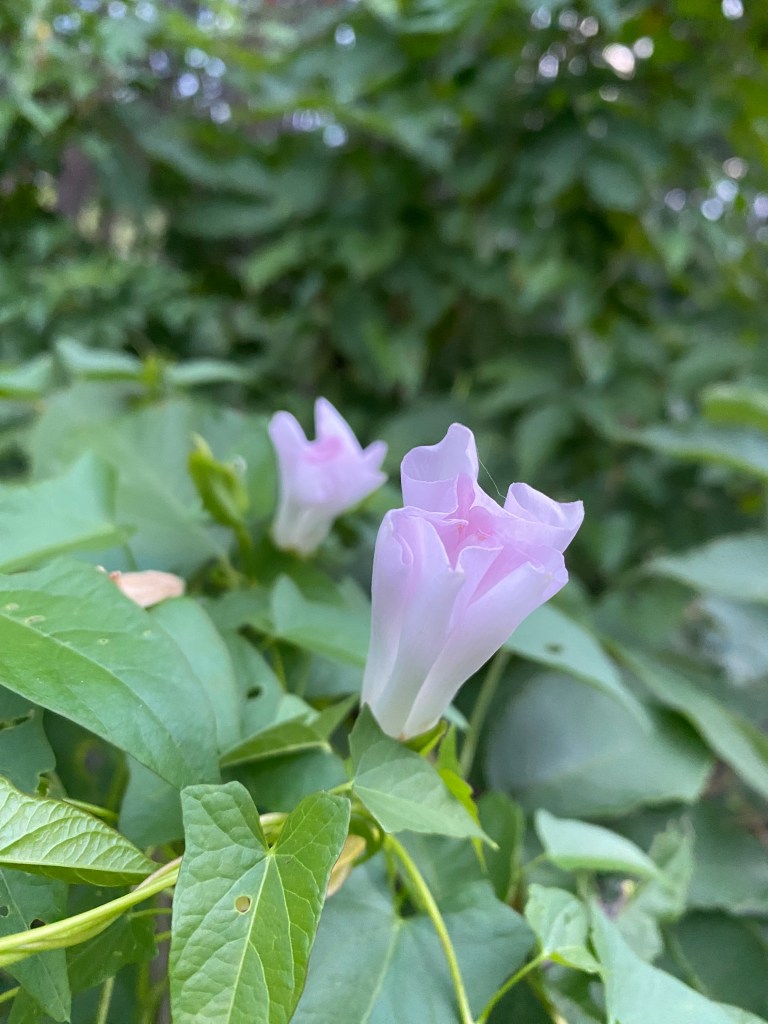
(photo by Tom Delaney, Sherburne County, Minnesota, 2025)
The August crescendo of summer here in Central Minnesota brings forth the short lived beauty of the hedge bindweed flower (Calystegoa sepium). These flowers on the vine may be in bloom for as little as one day, opening in the morning and closing by noon. The thing you can notice most about these flowers is their delicate purplish hue.
The Liturgy of the Word for today includes a reading from the book of Joshua:
For it was the LORD, our God…who brought us out of a state of slavery. He performed those great miracles before our very eyes and protected us along our entire journey… (Joshua 24).
Negative feelings are a natural and self-protective response toward hurt and the people who hurt us. It serves a good purpose initially. However, we as human beings are not designed to remain in a state of anger, resentment and rumination for a long period of time. Our flourishing requires freedom, and our freedom requires the ability to let go of negative emotions at the right time and through the right process. If the negative emotions we experience in response to a hurt or offense are not cleared out in a healthy way, we literally become held back from our own freedom and flourishing. When the negative emotions are so captivating that we find ourselves often revisiting them, maybe even uncontrollably, and maybe even in ways that start to control our behavior, we have fallen into the trap of slavery to those negative emotions.
Forgiveness researcher Dr. Robert Enright clarifies that the forgiveness process, done at the right time and in the right way is a release from these negative emotions:
The forgiveness process, properly understood and used, can free those bound by anger and resentment. It does not require accepting injustice or remaining in an abusive situation. It opens the door to reconciliation, but it does not require trusting someone who has proven untrustworthy, Even if the offender remains unrepentant, you can forgive and restore a sense of peace and well-being to your life. The choice is yours. (Forgiveness is a Choice, p. 43).
It is also important to know that it is OK to need help, guidance, and a clear path to forgiving someone. You don’t have to do it alone, and you don’t have to go at it blindly now that solid scientific research has validated things like the REACH Forgiveness model and process. And besides any guidance you can access through forgiveness education in your parish or community, it is so important to always remember that God is always your companion, making the full journey with you, just like the reading of Joshua says (it’s worth reading again):
For it was the LORD, our God…who brought us out of a state of slavery. He performed those great miracles before our very eyes and protected us along our entire journey… (Joshua 24).
This text is an original work of its author Tom Delaney and was entirely composed without the use of artificial intelligence (AI).
If your parish or faith community is seeking a deeper experience of healing, mercy, and spiritual renewal, Live and Forgive is here to help. To begin the conversation, email Live and Forgive presenter and facilitator Tom Delaney at tom@liveandforgive.com—Tom will be glad to connect with you in a spirit of welcome, respect, and shared faith.
 Live and Forgive