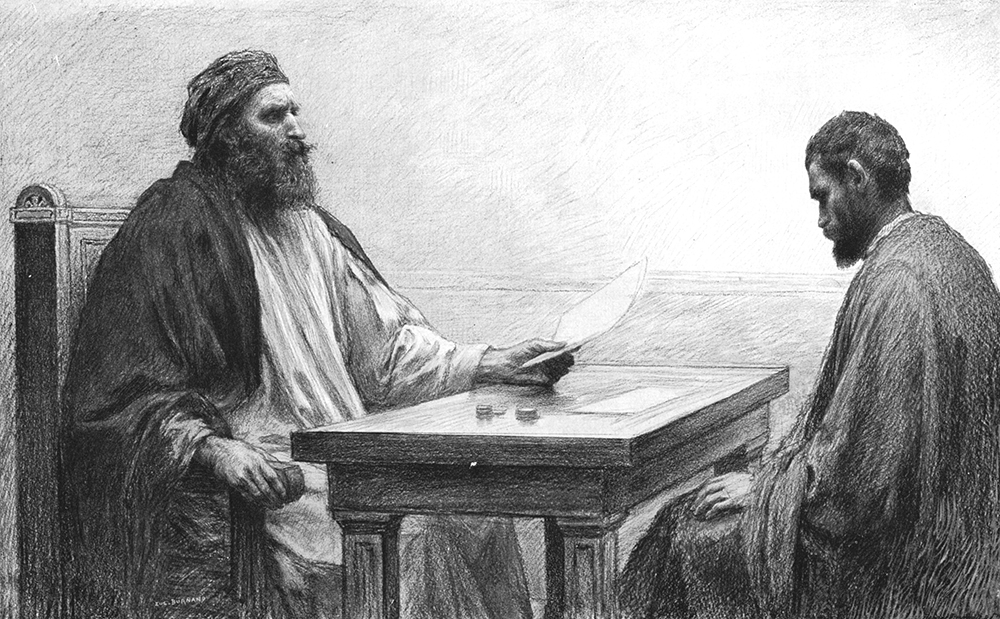
(photo: The Unjust Steward, Eugène Burnand, 1850-1921)
The reading fro the Gospel of Luke in yesterday’s Liturgy of the Word related the parable of the Unjust Steward (Luke 16:1-8). In this parable, a servant of a wealthy property owner is found to have squandered his employer’s assets, property, and holdings, and is told to prepare for his termination from employment. This steward has enough foresight about life after termination from employment to make him anxious about having to do real work, or to beg for money. Determined to find a way to protect himself from these things and land on his feet (as it were), he calls in the owner’s debtors and uses guile, and some ink and paper, to forgive large portions of their debt in order to ingratiate himself to them and ensure their gratitude and benefaction in his future jobless days. The order of events for the steward proceed from foresight, to anxiety, to guile (cunning, slyness, cleverness), to forgiveness (as an act, canceling debt), to future gratitude and benefaction. In the end, the owner finds out about it, and is so impressed with the steward’s cleverness (φρονίμως or “phronimós” in the original text of the gospel passage) and execution that he decides to keep him on!
The gospel concludes with Jesus challenging his disciples with a question which may be paraphrased as, “If people who are always hustling in worldly affairs of money have enough cleverness to have foresight and use shallow forgiveness to make a better future from the gratitude and benefaction of forgiveness, why aren’t you doing that even more?” I think the idea is that being a disciple (in its original sense of being a learner) of Christ means having foresight for oneself and realizing there is a future coming, a tomorrow. That tomorrow doesn’t necessarily even need to be apocalyptic and the end of the world, and probably isn’t, although it sure can feel like that sometimes. When you know there is a tomorrow coming, why not plant seeds for a tomorrow of gratitude and benefaction, by engaging in forgiveness? Even the guile of the steward teaches us that the more widely and more deeply one forgiveness, the greater the gratitude and benefaction that can be expected in the future. So why not forgive as widely as possible? As deeply as possible? So as to make for the tomorrows of the greatest possible gratitude and benefaction? It’s a very reasonable question!
I have often seen the parable of the Prodigal Son used as a hallmark example of forgiveness. However, I think that the parable of the Unjust Steward is a much better example. In this story you have all of the main concerns of forgiveness: transgressions, a justice gap, life impacts, emotions (anxiety), and forgiveness as an act to move relationships into gratitude and benefaction as a result of that forgiveness. The steward’s forgiveness is shallow and manipulative, but is also undeniably objective and clear — like any financial statement. It’s a great way to make a clear and familiar example in this story so as to consider the deeper forms of forgiveness based on empathy and love. This is a great forgiveness story!
For us, the opportunity and call is to think about tomorrow, and envision what the best tomorrow would look like in terms of our relationships. A tomorrow of groans, grudges, and grievances probably is probably not what we would call our best tomorrow. A tomorrow of generosity, gratitude, and good will probably looks a lot closer to our envisioned best tomorrow. As human beings, even as ordinary people, we have freedom, and we have an incredibly powerful tool to use in building our own tomorrow, along with an ever present opportunity to use that tool. That tool is forgiveness. Why wait any longer? Why not get to work today, on tomorrow? You can do it! And remember as well that you always have a coworker at your side, a friend and helper, a sublime craftsman — the son of a carpenter — Jesus, son of Joseph. Reflect, envision, and design your own best tomorrow. Do it again, and then use forgiveness to remove the groans, grudges, and grievances that aren’t part of that best tomorrow for yourself. As they say, “Measure twice, cut once!”
Please share these words with someone who needs them today.
This text is an original work of its author Tom Delaney and was entirely composed without the use of artificial intelligence (AI).
If your parish or faith community is seeking a deeper experience of forgiveness, healing, mercy, and spiritual renewal, Live and Forgive is here to help. To begin the conversation, email Live and Forgive presenter and facilitator Tom Delaney at tom@liveandforgive.com — he will be glad to connect with you for a conversation. Please type in your email and click “Subscribe” below to stay connected and get Live and Forgive articles delivered to you.
Take your learning deeper! Enter the term or word for any idea or thing you saw in this article that you want to know more about, and you will get a list of other articles that also talk about that idea or thing!
 Live and Forgive