
Winter is beginning its waning here in Central Minnesota. The sun rises just a little bit more to the north and the snow recedes revealing all the slumbering flora of last year. One could be tempted to excitedly announce the end of winter today, but the wiser person has patience and understands the longer and more gentle process of awakening that still must happen. That kind of patience and wisdom requires us to set aside from our own very limited ideas of how things ought to be and how they should proceed so that we can see and understand a much bigger picture. There is psalm in the Liturgy of the Hours for this past week that invites the same of us:
I will hear what the Lord God has to say,
a voice that speaks of peace,
peace for his people and his friends
and those who turn to him in their hearts.
~ Psalm 85 ~
All day long we listen to ourselves. We tell ourselves what is happening, who is doing it, and why they are doing it. This is the normal situation for each of us having what we call our “perspective.” You can probably figure out that our perspective is something like an interpreter who takes all the jumbled things that we see as separate from us and happening around us, and turns it into perceptions, thoughts, and explanations that we can work with mentally and use to respond to things around us in ways that try to get us what we want. You can probably figure out very quickly that, like an interpreter in a foreign land, your perspective is so important to your understanding of what is happening, that things can become risky when your perspective is not informed or accurate. In that circumstance, your responses to people around you are based on faulty information and bad translations. Of course, one challenge of the natural human situation is that we almost always have a personal perspective that is lacking information and not completely accurate in the information it does have. As a result of that, we do things based on misunderstandings, and we make mistakes.
The good news is that we can always try to improve the informativeness and accuracy of our own perspective. This effort is at the core of forgiveness of others that is full and enduring, not just for the forgiven person but just as importantly, for ourselves if we are t experience the physical, mental, and spiritual benefits of forgiveness that God almost literally has wired us to have. Full and lasting forgiveness requires that we open up our own perspective of what happened in order to have a bigger picture that includes the other person’s situation, past, and sameness with ourselves. In the most important ways, we do this by shifting from our own limited personal perspective, to seeking the perspective in “what the Lord God has to say” that is more much more informed, much more accurate, and that enables us to respond in a more compassionate, much wiser and more encompassing way.
Sacred Scripture: “God speaks to man in a human way”
The fastest and easiest way to hear what the Lord God has to say is to bend the binding on a Bible — and by that I mean reading Holy Scripture. The Catechism of the Catholic Church states it very simply and directly: “In Sacred Scripture, God speaks to man in a human way” (109, see also 104 & 135). That is good news for us, because it means that spending time reading Sacred Scripture is spending time listening to God speak to us. The more time we put into that, the more time we get out of it. Some of our time can also be not only reading and listening, but also thinking about what we have read and heard, both while we are engaged with reading as well as in the rest of our day as we go about work, relationships, and our experiences. This is the process of making what we have read part of our lives — weaving it into what we think, feel, and do. There is great benefit in setting aside some undistracted time for thinking about something we read in Sacred Scripture. One systematic and prayerful way to do this is by doing something called lectio divina, and the United States Council of Catholic Bishops provides good instructions on how to do that.
Correct interpretation and understanding of Sacred Scripture is important for us. The Catechism guides us by saying outright, “Sacred scripture must be read and interpreted in the light of the same spirit by whom it was written” (111). We understand Sacred Scripture to be inspired by the Holy Spirit (105). We also understand that our minds must be opened by Christ through the Holy Spirit in order to understand Sacred Scripture (108). The United States Council of Catholic Bishops has published a very good basic guide for reading and interpreting Sacred Scripture. You can also get guidance and support in prayerfully reading, reflecting upon, and responding to, Sacred Scripture with your parish priest or a qualified spiritual director in our Catholic Church.
Seven Steps to “Hear what the Lord God has to say…”
In addition to reading Sacred Scripture as a way to receive what the Lord God has to say, and especially regarding our forgiveness of others, we can also invest time in prayer and listening for what God has to say. Here is a seven-step process that I developed that works well for me and may work well for you. You can repeat this process as much as you need to do so. Here are the seven steps:
- Self-Awareness: We live in a world that works to distract us from ourselves. The first step toward hearing God is breaking off from the non-stop invitations and pulls away from just being where we are in the moment we are in with ourselves. It can feel like pulling together the scattered pieces of ourselves, at least mentally, and being whole again. A practical way to do this is to just sit in a chair, breathe, and feel yourself there in the chair.
- Choice: As humans, we have the power of choice available to us. Choosing something for ourselves commits ourselves in mental and physical ways. When we want to hear the voice of God, choosing to seek and listen to the voice of God is one of the most important things we need to do. We make a very important choice not to give the speaker’s podium and microphone to our own voice, perspective, and limited awareness and understanding, but instead give the speaker’s podium to God. A practical way to do this is to draw upon the Psalm 85 passage and simply say to yourself, “I will hear what the Lord God has to say.”
- Seeking: Once we have arrived in an undistracted awareness and made the choice to hear what God has to say, the next thing we need to do is listen for the voice of God. We’re not talking about an “out loud” voice that everyone else can hear, but rather a voice that speaks directly to us, directly to our awareness and understanding, that we experience as new awareness and understanding. We listen for it like the prophet Samuel: “Speak Lord, your servant is listening” (1 Samuel 3:10). If it helps, we can even say that out loud, as we listen for the voice of God to come to us. It is important to understand that this kind of seeking will take time, especially if it is new to us, and to have patience and confidence that eventually our seeking will undoubtedly end in finding (Matthew 7:7).
- Listening: With our patience, we will find the voice of God, perhaps small at first, but definite. Once we find the voice, the work is to actually listen, with all our attention and devotion. Openness is also important for our listening, especially when it comes to matters of accepting what God has to say in regard to forgiving people. As Paul shared in his letter to the Hebrews, “harden not your hearts” (3:15). Good listening is something we do, an action on our part, not just being receptive in a passive way that ends up with us regarding a voice as background noise. The Benedictine Rule renders it beautifully: “Listen carefully to your master’s instructions, and attend to them with the ear of your heart.”
- Acceptance: We are very capable of arguing with what we hear and bringing resistance against it, especially when what we hear calls upon us to make changes in our lives, changes in our relationships, or pulls the rug out from under some opinions, judgements, or perspectives that have become very comfortable for us and justify regarding other people as separate, less, undeserving, and unworthy. Acceptance of God’s word for our lives is what weaves it into our thoughts, feelings and actions. God already speaks to the importance of forgiveness in Sacred Scripture, and we should not be surprised when the voice of God that we hear speaks the same. If we need to forgive someone, both for our own good as well as theirs, we’re probably going to hear about it. At that point, it’s simply a matter of either accepting the reality that it is time to forgive, or continue clinging to our own judgements and ideas about why it is important to not forgive someone, even if for our own good.
- Response: We can have a passing experience of listening or a full experience of listening. When we have a full experience of listening, we are aware and acknowledge that we have heard, by adding our own participation in what is being said — something we call “response.” In a response, we use thought, word, and action to acknowledge what was aid and heard, perhaps also stating how we are experiencing what was aid — for example with gratitude, joy, or consolation. Response is a way to ensure that we are really having the fullest possible experience of our own listening to God’s voice. In practice, the response can be something you think in the moment, and it can be something you even say out loud. If you are feeling acknowledgement of the truth and wisdom in what you have herd, or feel a profound peace or gratitude, you can say the “Glory Be” in your mind our out loud: “Glory to the Father, to the Son, and to the Holy Spirit. As it was in the beginning, is now, and ever shall be, world without end.”
- Keeping: Words stay with us only as much as we choose to keep them. If we make the choice to keep what God has to say to us, it opens the way to weaving those words into our thoughts, feelings, and actions in our choices, relationships, and everyday life. Memory is one way to keep words, and another good way is to keep a written journal. When you have a journal, you have a permanent archive of what you have received, and can refer back to it as often as you need to for renewal.
Should you consider help from your parish priest or a spiritual director?
You can certainly benefit from working with your parish priest or a qualified spiritual director in the Catholic Church when you work this process, especially when forgiveness for others is an important part of your life that you need to work with. There can be mental and lifestyle obstacles, occasional pitfalls, frustrating dry spells, and very human wrong turns, and your parish priest or a qualified spiritual director can help keep you on track and moving forward. In this same regard, it is important to have patience with the process and patience with yourself. Don’t ever let the process become some kind of measure of whether God loves you or not, or whether you are a good person or not, or whether your life has any worth and meaning. Those things are absolutes and non-negotiables before and whether or not you start the process: God loves you, you are created and essentially a good person, and your life is incredibly worthy and awesomely meaningful.
Should you consider therapy with a mental health professional?
If you are a person who has experienced trauma, either recently or in your childhood, it is important for you to work with processing that trauma and its impact in your life by connecting with a qualified mental health professional. The same goes for you if you know you are struggling with your feelings, whether anger, anxiety, or depression. The seven-step process is no substitute for good work in your life to address trauma and its impacts, and work with difficulties of anger, anxiety, or depression. If you’re not sure, better to be safe and just check in with a mental health professional and do somethings to find out how you’re doing with your own mental health. The seven-step process is not therapy, bus is a process of spiritual unfoldment that can be powerfully bolstered by work you do to improve and optimize your mental health — and physical health too!

If you ever feel like you need help immediately, or are experiencing a mental health crisis, please call 988 and you will be quickly connected with someone who will help you, It is free, and it is a good way for you to give God a chance.
Is it ever too late to listen? Do you ever run out of chances?
I want to finish by saying that it’s never too late to start being intentional about “hearing what God has to say.” In the same way, if you were listening and got distracted, stopped listening, or just did not want to hear it at that time of your life, you can always choose to give listening a chance again. God doesn’t walk away from you when you’re not listening. God is always there not just by you, bur for you. In that moment when you decide to make even the smallest effort to listen again, God will for sure be there. You can trust in that.
Take some time for yourself today, and either find a verse in Sacred Scripture that connects with you, or try even just the first step in the seven-step process. You can try the second step too if you feel ready. Sometimes practicing just t aking abreak and sitting quietly is enough for today. Feel good about the choice you make to give it a chance.
Please share these words with someone who needs them today.
This article is an original work of the author and was not composed by or with artificial intelligence (AI). The author is solely responsible for the contents of this article and the opinions and perspectives expressed in the article are solely those of the author.. © 2026 Thomas Delaney. All rights reserved.
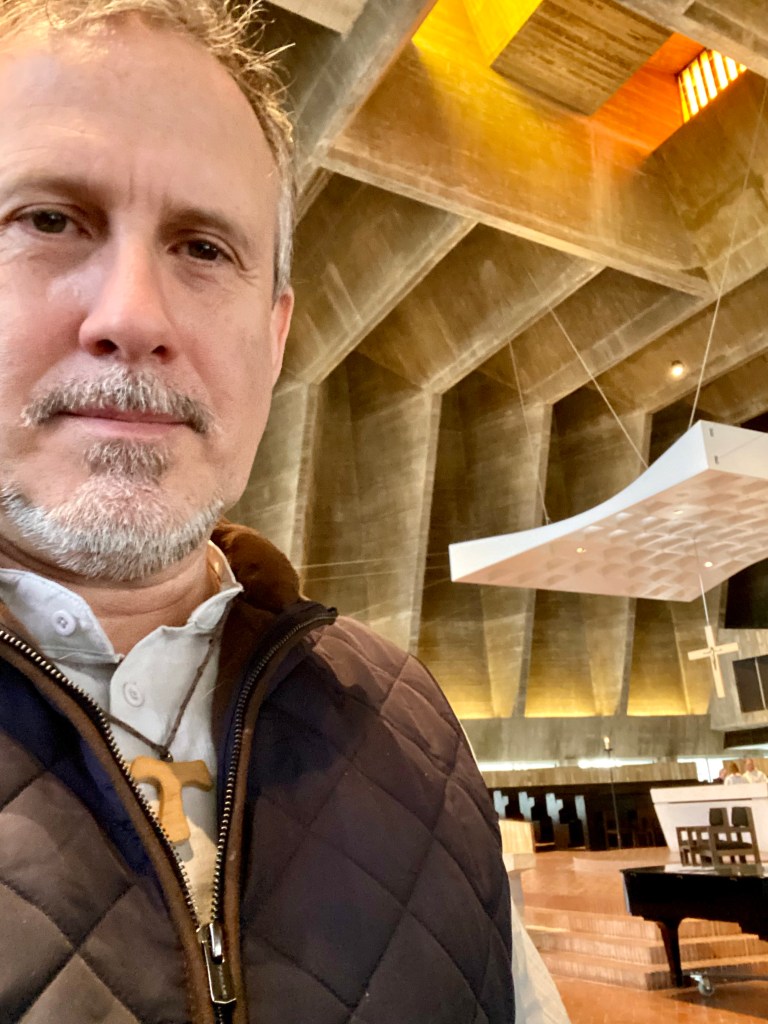
photo: Thomas Delaney O.F.S., 2026
If your parish or faith community is seeking a deeper experience of wellness and forgiveness as a foundation for inner renewal and spiritual growth, Live and Forgive is here to help. To begin the conversation, email Live and Forgive presenter and facilitator Tom Delaney at tom@liveandforgive.com — he will be glad to connect with you for a conversation.
Please type in your email and click “Subscribe” below to stay connected and get Live and Forgive articles delivered to you.
Take your learning deeper! Enter the term or word for any idea or thing you saw in this article that you want to know more about, and you will get a list of other articles that also talk about that idea or thing!
 Live and Forgive