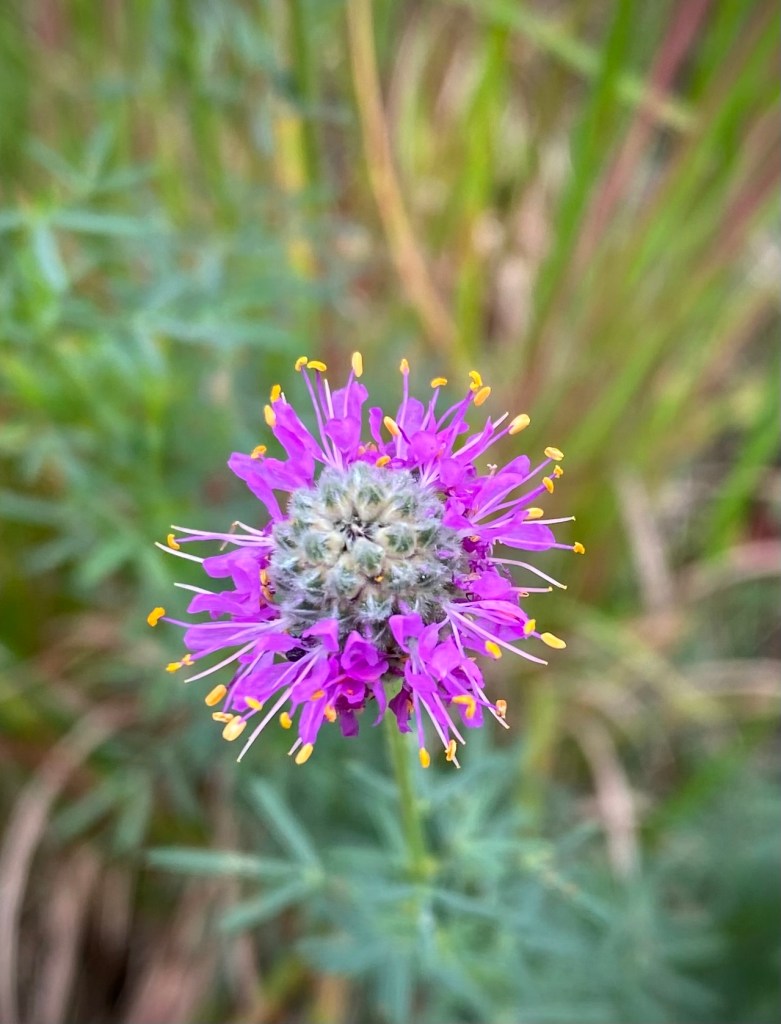
(photo by Tom Delaney, Sherburne County, Minnesota, 2025)
The days are turning cooler here in Central Minnesota, and the night chorus of crickets swells. Purple Prairie Clover (Dalea purperea) is a one tow watch all summer long, and these days are no exception. Purple Prairie Clover is a native species or prairies in Minnesota, and so it is always good to see it thriving in our grasses on the oak savanna.
Today’s gospel reading in the Liturgy of the Word is from Luke 12:49-53, and includes Jesus speaking: “I have come to set the world on fire, and how I wish it were already blazing!” This section of scripture is an attention grabber for sure, and I can’t help that is exactly the effect Jesus was intending. It sounds dramatic, because people of his time already regarded fire as a potent transformative force. In the home, it transformed dark spaces into lit spaces, cold spaces into warm spaces, turned flour and water into bread, and turned water and beans into soup. At the same time, entire cities had been legendarily burned to the ground, transformed into bare ashes. Assuredly, when fire was around, things were going to change. Even in the synagogue, it was known that God had recruited Moses speaking from a burning bush, and later on led the Israelites through the desert with a column of fire. In both cases, big changes – transformative changes – were on their way.
Francis of Assisi included fire in his very insightful composition known as the Canticle of the Creatures:
Praised be You, my Lord, through Brother Fire,
through whom You light the night,
and he is beautiful and playful and robust and strong.
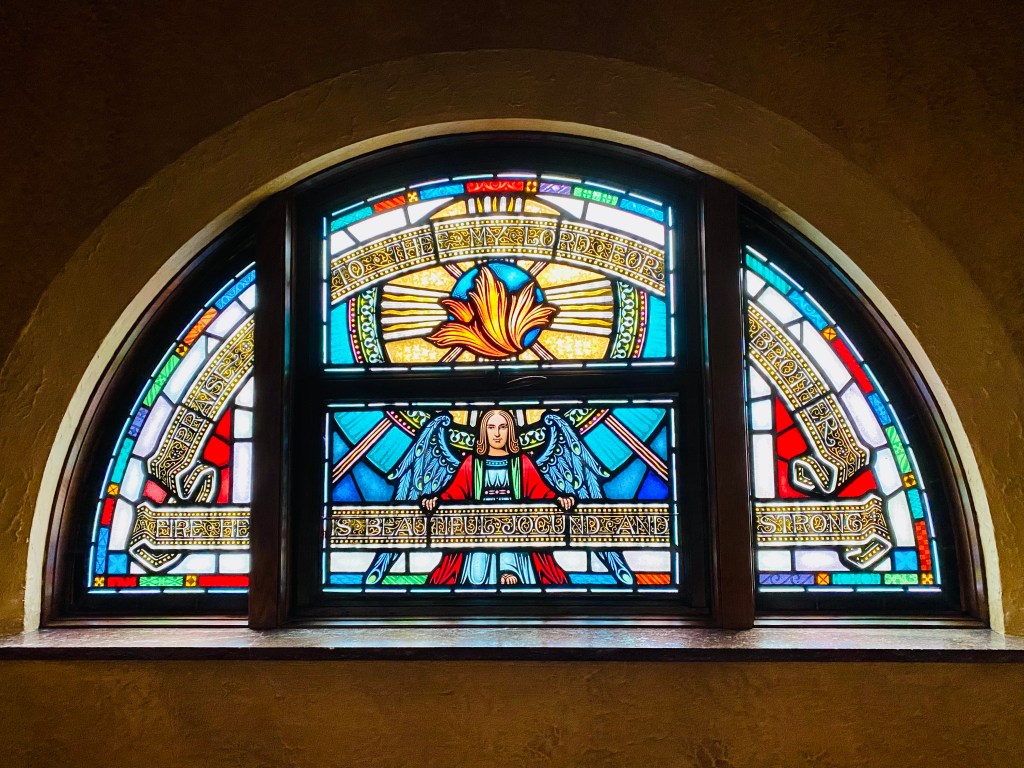
(photo by Tom Delaney, St. Francis Convent & Campus, Little Falls, Minnesota, 2023)
What is special about Francis’ wise words is his attention to God being praised through fire. In addition, Francis sees God as working through fire as well, in lighting the night – perhaps not only the literal sense of the night of the day, but also in a spiritual sense those times when we feel ourselves lost in darkness but then come upon some light that helps us out. Francis puts words to the different ways we experience fire: beautiful and playful, yet also robust and strong. In this way we can understand not only that fire is transformational (it changes things from one way of being to another), but also especially part of the human experience of our own lives. Fire is always there to be close to us, and there to be transformational for us…and even more importantly…of us.
Forgiveness is not just a transformational act, it may very well be the most important transformational act. Of all of the things Jesus could have said at his crucifixion, we remember him saying, ” Father forgive them, for they know not what they do” (Luke 23:34). In that moment, humanity was transformed. The situation radically changed. No one was going to be the same after that. From that point on, it is all about Jesus’ crucifixion as the greatest altruistic act, ever and ever to be, for the divine economy and the salvation of humanity. The greatest example of forgiveness for all time.
The transformative power of forgiveness is something we can still gift ourselves. In the example of the greatest example, we can choose to forgive and experience personal transformation through forgiveness. Through forgiveness we can let go and leave behind one way of being, and become into a transformed and better way of being. Sort of like Newton’s Third Law, to move forward, we have to leave something behind. When done right, it is a rock solid, sure fire, very reliable way to experience personal transformation. The more you do, the more you experience transformation. Life changing? — yes, my friend. When you commit to forgiveness in the example of Jesus Christ, you move into a new relationship with Jesus Christ: “…you are in me, and I am in you” (John 14:20). And that’s when you change, and because you change, a lot of things you thought you knew change too: “So if anyone is in Christ, there is a new creation: everything old has passed away; see, everything has become new” (2 Corinthians 5:17) … And that is transformation.
Jesus said that he came to set the world on fire. We can understand those words to mean that he came to transform the world and everyone in it into a new way of being. We can see it in his crucifixion, as the greatest example of transformation in forgiveness. Most importantly, we can choose forgiveness to experience our own personal transformation … the personal transformation that is intended for us and that every fiber of our being is waiting for.
This text is an original work of its author Tom Delaney and was entirely composed without the use of artificial intelligence (AI).
If your parish or faith community is seeking a deeper experience of healing, mercy, and spiritual renewal, Live and Forgive is here to help. To begin the conversation, email Live and Forgive presenter and facilitator Tom Delaney at tom@liveandforgive.com—Tom will be glad to connect with you in a spirit of welcome, respect, and shared faith.
 Live and Forgive