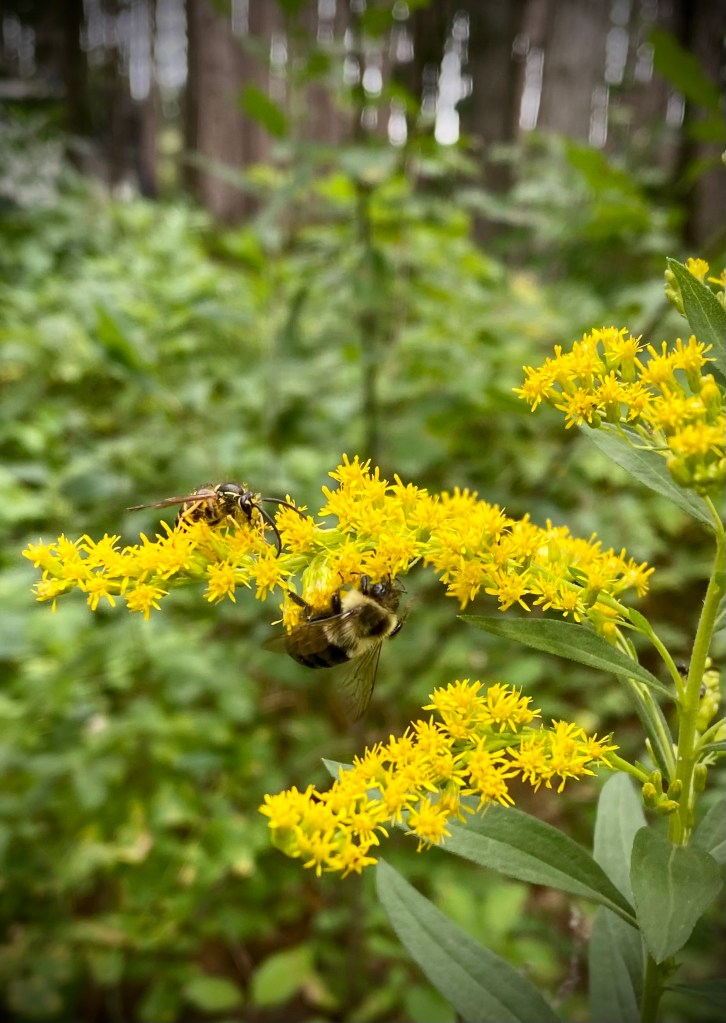
(photo by Tom Delaney, Sherburne County, Minnesota, 2025)
This is the time of year when the Canada Goldenrod (Solidago canadensis) is in bloom and we can see all kinds of pollinators busily working the flowers. As you can see in the photo, it’s an amazing sight of coexistence, not to mention that you may be surprised that wasps in quest of goldenrod nectar are pollinators as well and an important part of the health of the local ecosystem.
Live and Forgive is a product of the training and ongoing support that I receive from the Human Flourishing Program at Harvard University. The Human Flourishing Program supports forgiveness and forgiveness campaigns at the community and global levels as an important component of supports for human flourishing at those levels, and including the personal level within those. Dr. Tyler Vanderweele is the director of the Human Flourishing Program, and recently has an article published in Psychology Today about flourishing at the end of life. In this article I will share some highlights from Dr. Vanderweele’s article, with some additional thoughts of my own.
The definition of human flourishing that the Human Flourishing Program uses is, “the relative attainment of a state in which all aspects of a person’s life are good, including the contexts in which that person lives.” Human flourishing is understood to be an ideal, a lifelong goal with inexhaustible potential and linked possibilities for a person. It is also understood as being multidimensional, reflective of the many capabilities that make us human. The inexhaustible potential and linked possibilities of human flourishing, as well as the multidimensionality of human flourishing, are also understood to be lifelong, with important defining characteristics at all stages of life, and especially our elder years.
Engagement with forgiveness and reconciliation can be linked to human flourishing in the elder years in very important ways. The elder years are years when a personal understanding of the meaning of one’s life has been unfolding over years of time. I have to add that Ronald Rollheiser offers some very good insights into aging and spirituality in his book Sacred Fire: A Vision for a Deeper Human and Christian Maturity. In the elder years, one’s future trajectory of flourishing may still be altered by life events. At the same time, one’s understanding of the past may also change in important ways, including past hurts and transgressions. These changes in understanding and perspective can make forgiveness more important than previously, and also make forgiveness more motivated and easier with that changing perspective of what life is all about. It’s an important part and positive possibility in growing older.
The elder years, and especially in moving toward the end of one’s life, are an important time for personal relationships. Bringing a satisfactory conclusion to relationships can become important at this time of life. There are often unique opportunities for forgiveness and reconciliation when relationships have been broken in the past.
The Reach Forgiveness Process, and the Bridge to Reconciliation Process, both taught in Live and Forgive presentations, guided retreats, small group series, and wilderness walks, can have special relevance and importance for elder members of parishes and communities. Both processes can help elders work with their seasoned perspective of the meaning of life, and what’s important in life, in ways that can bring forgiveness and reconciliation to past and current personal relationships.
This text is an original work of its author Tom Delaney and was entirely composed without the use of artificial intelligence (AI).
If your parish or faith community is seeking a deeper experience of healing, mercy, and spiritual renewal, Live and Forgive is here to help. To begin the conversation, email Live and Forgive presenter and facilitator Tom Delaney at tom@liveandforgive.com—Tom will be glad to connect with you in a spirit of welcome, respect, and shared faith.
 Live and Forgive