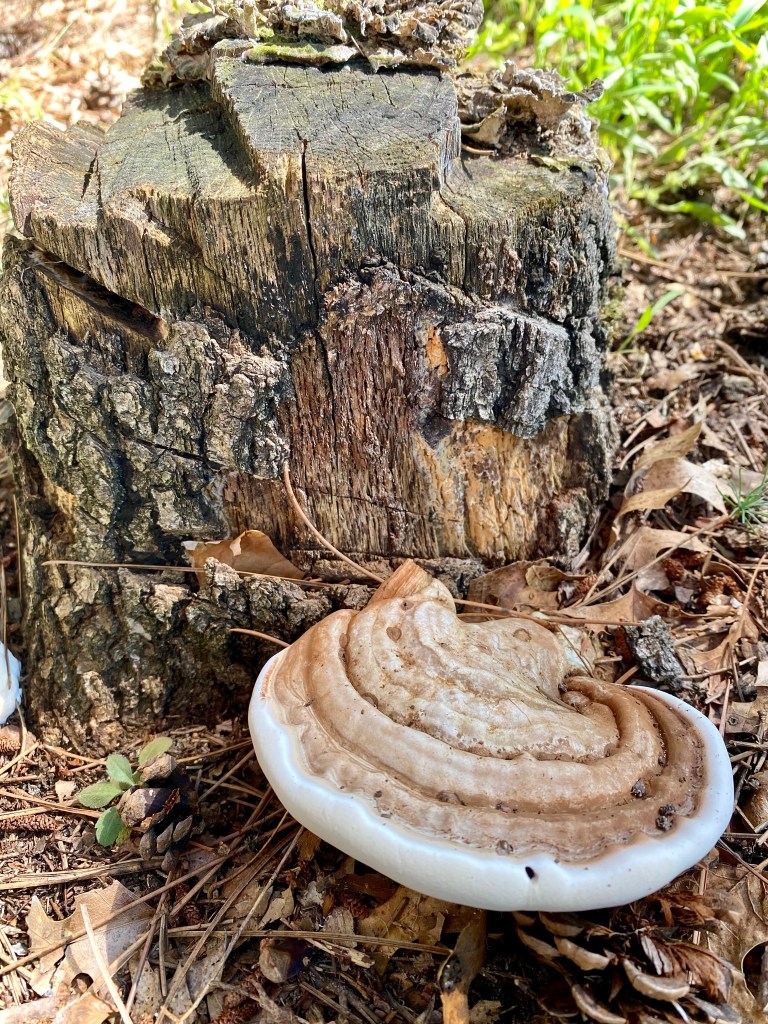
(photo: Artist’s Conk, Tom Delaney, Sherburne County, Minnesota, 2025)
The mixture of hardwood oaks and aspens along with softwood pines and junipers makes for a wide variety of mushrooms and fungi in our little corner of the oak savanna. I took a photo of this Artist’s Conk (Ganoderma lobatum) in our woods and I’ll be honest…because I really love pancakes. The soft ivory and tan hues of the Artist’s Conk, especially with the brown center and ivory edge, easily catch my eye in a walk through the woods and my mind’s inner voice yells “Look! We found pancakes! Yes! Good job!” As it is, it’s a woody fungus that probably doesn’t get better with butter and syrup. Sooo…we can and probably should appreciate the Artist’s Conk for what it is — itself. One more note: the Artist’s Conk is called the “artist’s” because the white underside of it stains brown wherever you etch it, such that you can use it as a kind of woodcut medium for drawing. Sounds cool but I haven’t tried it.
Why is real forgiveness a process? It’s a very good question! We definitely appreciate when something we want for ourselves can be immediately obtained. When we want light, we can flick a switch. When we want heat, we can flick a switch. Imagine if you had to rub two sticks together every time you wanted light and heat! That would be quite a process! As it is, making light and heat still involves a process, but we figured out how to locate that process outside of our living rooms, so that we just access the product when we unthinkingly flick the switch in our living rooms. The same situation happens when we pull a bag of carrots out of our refrigerator. The processes of seeding, growing, and harvesting are located somewhere else, and we just access the end of the process.
There are so many possible examples. The insight may be that the world is full of processes, making everything we know happen, and that for anything its impossible to not have a process involved. In a previous post, I said that we can see that we’re in a cause-and-effect world. Maybe what that means is everything is a chain of cause-and-effect events in one way or another. It makes me ponder whether all of these cause-and-effect chains of events are combined with each other in a way that makes everything interconnected in what looks like a complex, beautiful and ornate spider’s web at one level, but also very simple at the level of the closest look…or our human experience of a single event. Of course, with all these cause-and-effect chains, it seems like everything is headed somewhere, toward some next situation of things, or even an ultimate end point. Are we, as people, going somewhere in that way? Am I, as the person I know myself to be, also going somewhere ultimately? That has to be true if I am part of the big beautiful spider web, right? Just something I think about, and if you think I am baiting you to do the same, you’re right.
Forgiveness, when its done right, offers us a number of benefits that we may be looking for in our lives:
- Decreased feelings of anger and hostility, more feelings of inner peace.
- Improved heart health and less chances of heart disease.
- Improved mental health and less chances of depression and anxiety.
- Fulfillment of our personal sense of living faith and grace,
- Fulfillment of our personal sense of moral virtue.
- Development of positive self-identity and sense of purpose in life.
- Feeling good, sense of peace and happiness.
- Improved relationships with others, friends and family.
With so many benefits, it is natural that we would look for a way to obtain those benefits immediately or as quickly as possible — back to the living room switch, right? Forgiveness researcher Everett Worthington, who developed the REACH Forgiveness Process taught in Live and Forgive, figured out that there is a fast form of forgiveness that he termed decisional forgiveness. In decisional forgiveness, we:
- Decide and promise not to act in revenge or avoidance of the person who hurt us.
- Agree to control our negative behavior.
- Use acceptance of the event and move on with our lives.
- Defer judgement to others or to God.
- Convince ourselves the transgression was not as harmful as we initially thought.
- Restore the relationship to what it was prior to the transgression.
- Hope to reduce negative emotions and motivations in our future.
In many cases, people will engage with decisional forgiveness because it is a relatively fast solution, often fulfills the person’s moral sense of what is right and best to do, and gives some relief. That all said, Worthington researched decisional forgiveness and found that it does not really constitute full forgiveness. Decisional forgiveness can still leave you with the negative emotions of unforgiveness: resentment and bitterness. Decisional forgiveness itself can have problems enduring over time. When these two things combine, you’re left still feeling negative emotions, and you likely get to a point where the forgivness has run out and you’re back where you started from. Something else is needed to attain full and lasting forgiveness…and that something else is a good forgiveness process.
Forgiveness researcher Robert Enright helps us understand that real, full, and lasting forgiveness is a process for some very important reasons:
- Deeper hurts require more time for forgiving than others.
- We do not all forgive in the same way…but it is a way, something we do with effort over time.
- We often need to revisit the things that make forgiveness more than once.
- Our attitudes change with our experiences over time, and forgiveness depends upon a change in our attitude over time to do the work. That way we can revisit the things that make forgiveness (see above) with the benefits of new experiences and new attitudes over time.
- Deep anger and resentment rarely happen from a single event, and more often result from many events over time. Forgiveness mirrors this by also being something we do over time.
- Destructive relationships are often the cause of hurt, and one destructive relationship often leads to another destructive relationship. Forgiveness has to be a process of peeling back the layers of hurt and pain caused by destructive relationships. Peeling takes time and effort.
- The forgiveness process can be different for different people, and some people need more time to work through forgiveness than others.
- We mat forgive at one level, and then get angry again months or even years later because the surface anger was hiding deeper hurts.
- You can forgive a person and an event, and then find that anger is back in your life. It just means that there is probably something or someone else for us to forgive. Don’t be discouraged.
- Forgiveness is a skill and a personal capacity that we get better at through practice over time.
- When we practice and improve our ability to forgive over time, and do that by forgiving more and more people and events over time, it will result in our transformation.
If there is a process involved in everything we know and experience, we can understand that forgiveness is not an exception. As a person, we are always working a process of living our potential and becoming the full human being that we can be — that’s human flourishing. It is so important and primary to understand, that it’s in the very first paragraph of the Catechism of the Catholic Church:
God, infinitely perfect and blessed in himself, in a plan of sheer goodness freely created man to make him share in his own blessed life.
The paragraph conveys that God literally has a plan, a mapped process that unfolds over time, for you. A plan and process that is designed to deliver you to goodness and a blessed life. Always remember that!
Forgiveness has to be a process, because we are the embodiment of our own process. The good news for us human beings is that we can develop greater awareness of process at work in our lives every day: around us, within us. When we become more aware of process, we can step into it and start using the dynamic of process to make our lives better, as well as the lives of those around us. The best thing about process is that it brings possibility and change. We can be in a very tough situation, but we can also know that things can and will get better with the right use of process. The universe is wired for it! We are wired for it. Find joy and peace in the process that is you.
This text is an original work of its author Tom Delaney and was entirely composed without the use of artificial intelligence (AI).
If your parish or faith community is seeking a deeper experience of healing, mercy, and spiritual renewal, Live and Forgive is here to help. To begin the conversation, email Live and Forgive presenter and facilitator Tom Delaney at tom@liveandforgive.com—Tom will be glad to connect with you in a spirit of welcome, respect, and shared faith.
 Live and Forgive