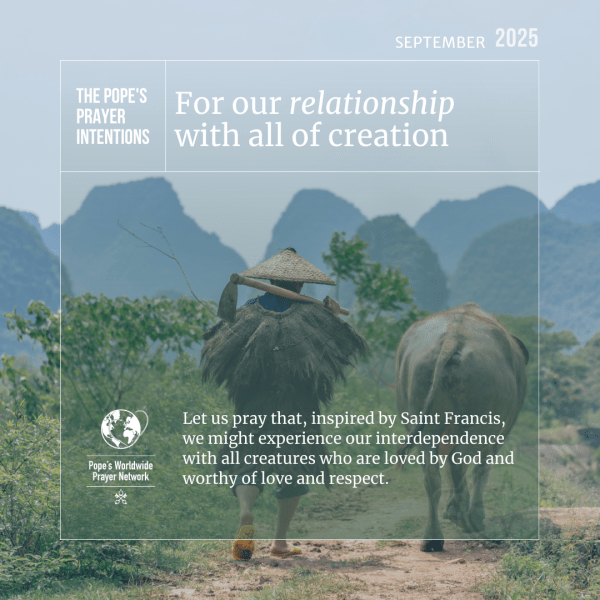
(photo: Pope’s Worldwide Prayer Network, 2025)
The Vatican News reports that Pope Leo XIV has announced a prayer intention for this month of September “for our relationship with all of creation.” In his explanation available via video. Pope Leo XIV specifically recognizes the “the beauty of creation” as a revelation of God and “as the source of goodness.”
The announced September prayer intention connects with forgiveness in important ways. Pope Leo XIV’s recognition of creation and the natural world as a revelation of God and a very real “source of goodness” is something that can be accessed and drawn upon to aid us in the forgiveness process. When it comes to how contact and connection with nature can help us in a forgiveness process, here’s a short list of research-validated effects of spending time with nature from Colin Capaldi and colleagues (2015):
- Connection with nature satisfies our attraction and need for that connection within ourselves.
- Satisfying our attraction and need for connection with nature improves our sense of well-being.
- Being in nature has a restorative effect for our mental abilities of attention and concentration, as well as our emotional abilities.
- Natural environments remove us from daily life stimuli that cause us to constantly and urgently respond without paying real attention to how we are thinking, feeling, and acting.
- Nature provides stimuli that appear rich and fascinating to us, and that engage our attention without exhausting us mentally and emotionally.
- Time spent in nature decreases our arousal and stress levels.
- Being in nature promotes stress recovery for the mind and body (i.e. psychophysiological stress recovery).
- Spending time in nature acts as a buffer against current and future stress.
- Contact with nature reduces heart rates, levels of the stress hormone cortisol in our bodies, and improves our immune system functioning.
- Even brief contact with nature, like a short walk, promotes positive emotional states.
- Connection with nature relates to feelings of happiness, promoting positive affect and life satisfaction.
- Contact and connection with nature is linked to feeling that one’s life is meaningful.
- Time in nature promotes self-perceptions of increased autonomy and freedom to choose one’s actions.
- Being in nature is linked to feeling that you can be your authentic self freely.
- Spending time in nature is associated to feeling vitality, fully feeling alive and energized.
- Researchers have linked connection with nature to “feelings of awe and inspiration, connection to a greater whole, and spiritual exaltation—the transcendent aspects of eudaimonic well-being” (human flourishing).
- Research validates that connection with nature is closely related to our spirituality.
Contact and connection with nature can help us at any stage of the forgiveness process, from just getting the initial self-awareness of how we feel in our state of not forgiving someone, to feeling that we have the energy and safety to begin the process of forgiving someone, all the way through completing the process of fully forgiving someone. At any and all of those points, the things I listed as the positive effects of contact and connection with nature can help us. They can help us because, as Pope Leo XIV stated, they are revelatory of God’s real presence, and are the goodness of creation that was set up for our happiness and that we ourselves are set up to receive and benefit from.
I think two more points are notable specifically about the relationship of connecting with nature and spirituality. One is that connecting with nature, being in a natural setting, surrounds us with visible representations of universal principles that are key to our spiritual growth and well-being: birth, growth, flourishing, resilience, healing. They are all visible in one way or another as you see trees, plants, animals and land features along any typical troll through the woods or grasslands. It’s a world of signs because the things you see also contain the reality they signify. In that way, it is also a world of analogies for our own spiritual selves, enabling us to visibly see those principles within ourselves and express ourselves as analogous to these signs in nature. For example, the Liturgy of the Word for today includes Psalm 52:10, and a prayer that “I, like a green olive tree in the house of God, trust in the mercy of God forever and ever.” The green olive tree is an analogy for our trust that God will give us what we need to grow and flourish. My second point is that the Gospel narrative includes Jesus removing himself from crowds and clamor so as to go to places of wilderness and nature for prayer and renewal. Again, the Liturgy of the Word for today includes Luke 4, and relates that, “At daybreak, Jesus left and went to a deserted place.” The need to get away, rest, restore and renew is understandable, and wilderness was the go-to for Jesus. In Mark 6:32, Jesus told his disciples, “Come away by yourselves to some deserted place (ἔρημον in the original Greek of the New Testament) and rest a while.” Centuries later, John Muir would say basically the same thing: “Come to the woods, for here is rest.” The connection of our sense of well-being to connection with nature is ancient, and probably holds the key to our sense of well-being in the centuries to come as well. We can look forward to that.
September is a good month to put together Pope Leo XIV’s prayer intention for creation, with the help that connection with nature does for a forgiveness process. The REACH Forgiveness Process that can be taught in Live and Forgive presentations, guided retreats, or small group series, can also be facilitated in the setting of creation and nature, especially using a walk in a natural setting for each step of the REACH Forgiveness Process. This element of connection with nature as part of the REACH Forgiveness Process can be as simple as just a one-day or half-day Live and Forgive event, or can be a recommended practice within a Live and Forgive small group series happening over weeks or months. Nature is flexible for us that way.
Before signing off, I want to recommend two readings that can help us connect with nature in ways that make us more aware of God’s revelation in the natural world, and the goodness of the natural world. The first is St. Francis of Assisi’s Canticle of the Creatures (also known as the Canticle of Creation or the Canticle of the Sun).
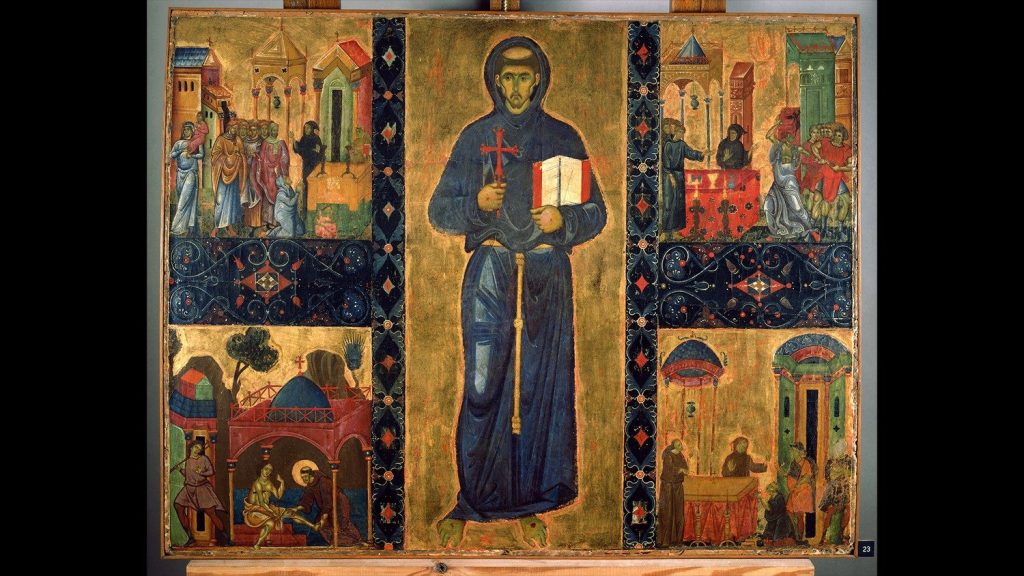
(photo: St. Francis of Assisi)
The second reading I would like to suggest is Daniel 3:57-90, which lists even our Minnesota adversities of snow, frost and chill. You can change your attitude and relationship to winter weather! … and see the beauty of it, and God’s revelation in it.
Spend some time with nature today, at any scale: forest or houseplant, great herd or house pet.
This text is an original work of its author Tom Delaney and was entirely composed without the use of artificial intelligence (AI).
If your parish or faith community is seeking a deeper experience of healing, mercy, and spiritual renewal, Live and Forgive is here to help. To begin the conversation, email Live and Forgive presenter and facilitator Tom Delaney at tom@liveandforgive.com—Tom will be glad to connect with you in a spirit of welcome, respect, and shared faith.
 Live and Forgive