
(photo: Скорбящая Mать, Sergey Cherny, 2012)
Forgiveness models and processes often involve moral distress and moral injury a person has experienced, including in practicing a forgiveness process in small groups and guided retreats. Having good definitions of moral distress and moral injury and an understanding of their relationship can improve the quality of forgiveness processes in ways that support full and lasting forgiveness. As a forgiveness educator and group facilitator, I can use these definitions and my understanding of moral distress and moral injury to optimize the experience of participants in Live and Forgive presentations, guided retreats, small group series, and wilderness walks. The definitions can help participants identify and understand their experience of moral distress or moral injury so that they have more perspective of the hurtful event that they are working on forgiving, and a full view of the impact of the hurtful event in their lives.
I started Live and Forgive while completing a program in forgiveness education and forgiveness group facilitation in the Human Flourishing Program at Harvard University, and still receive ongoing support from the Human Flourishing Program. Dr. Tyler VanderWeele is the director of the Human Flourishing Program. In a recent publication of their research, Tyler VanderWeele and colleagues have proposed important new definitions of moral distress, moral injury, and moral trauma that people may experience in and as a result of a hurtful event. I am going to share with you the main points of their research that pertain to supporting participants in a forgiveness process, like those facilitated through Live and Forgive, when they have experienced moral distress and moral injury:
- Moral Injury: Persistent distress that arises from a personal experience that disrupts or threatens:
- one’s sense of the goodness of oneself, of others, of institutions, or of what are understood to be higher powers; or
- one’s beliefs or intuitions about right and wrong, or good and evil.
- Moral injury may be experienced in a single event or in a recurrent series of events.
- Moral Integrity: One’s sense of the goodness of oneself, of others, of institutions, or of what are understood to be higher powers, or one’s beliefs or intuitions about right and wrong, or good and evil.
- Moral Distress: Distress that arises because personal experience disrupts or threatens: (a) one’s sense of the goodness of oneself, of others, of institutions, or of what are understood to be higher powers, or (b) one’s beliefs or intuitions about right and wrong, or good and evil.
- Potentially Morally Injurious Event: Events that in and of themselves may, or may not, potentially give rise to moral injury and distress.
- A potentially morally injurious event may give rise to moral distress for one person and not another person, depending upon their moral understanding, certainty of moral beliefs, understanding of their own identity, and a host of other factors.
- A morally traumatic experience (MTE) happens when a potentially morally injurious event does give rise to moral distress by threatening or disrupting one’s moral understanding.
- Morally Traumatic Experience: Personal experiences that disrupt or threaten: (a) one’s sense of the goodness of oneself, of others, of institutions, or of what are understood to be higher powers, or (b) one’s beliefs or intuitions about right and wrong, or good and evil.
- The morally traumatic experience is the origin of the ensuing moral distress, which, if persistent, constitutes moral injury.
- When a morally traumatic experience causes moral distress that is so persistent and severe that it substantially impedes one’s capacity to function, in a way that is outside the range of societal norms, it may be referred to as moral injury disorder.
- Moral Injury Disorder: Persistent distress that arises because personal experience disrupts or threatens: (a) one’s sense of the goodness of oneself, of others, of institutions, or of what are understood to be higher powers, or (b) one’s beliefs or intuitions about right and wrong, or good and evil, so as to cause impairment in social, occupational, or other important areas of functioning in ways that are out of proportion or inconsistent with cultural or religious norms concerning such experiences.
- Moral Trauma Spectrum:
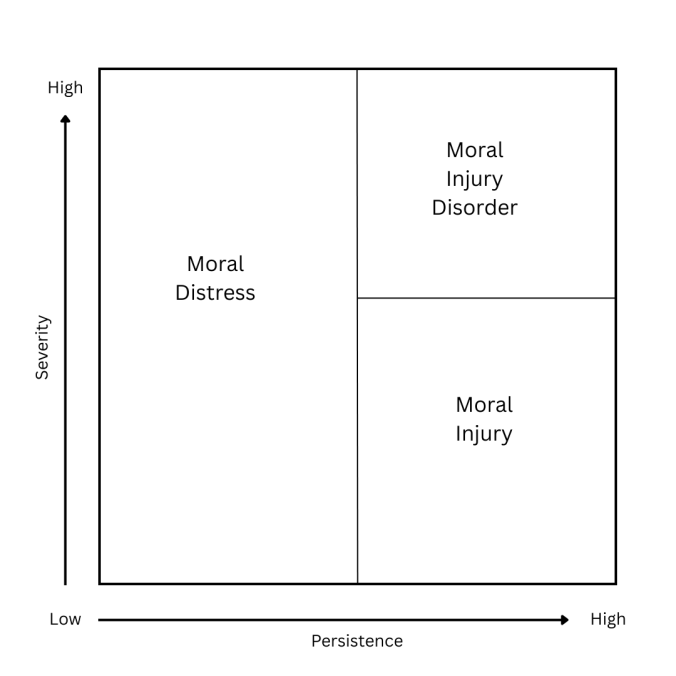
- The severity of moral distress and moral injury can depend upon the resources and social community available and accessed by a person.
- The severity of moral distress and moral injury has three dimensions: (a) extent of moral disruption, (b) distress symptoms, and (c) functional impairment.
- Moral disruption may involve one’s sense of the goodness of oneself, of others, of institutions, or of God or one’s beliefs or intuitions about right and wrong, or good and evil.
- Moral distress may involve guilt, shame, betrayal, anger, or other moral emotions.
- Functional impairment may involve one’s work, or social relationships, or other areas of day-to-day functioning.
- The ideal approach to treatment of moral injury disorder is a team of chaplains, behavioral health specialists, and physicians that would together provide coordinated care.
- Ten core signs of moral distress or moral injury are:
- guilt
- shame
- feelings of betrayal
- anger
- feelings of powerlessness
- feelings of hopelessness
- feelings of loss of meaning
- struggle with faith
- struggle with forgiveness
- loss of trust
- Basic questions to look for and approach possible moral distress or moral injury:
- “Is something severely disrupting your moral beliefs or your sense of goodness of yourself or others?”
- “Have you done or experienced something that is severely disrupting your moral beliefs or your sense of goodness of yourself or others?”
- If yes to either, ““Would you like to describe what took place, or what you did, or what the experience was?” so as to better understand the nature of the morally traumatic experience.
- Moral trauma definitional items regardless of moral trauma type (yes/no or scale responses for each):
- Because of what I experienced, I question my beliefs about good and evil.
- Because of what I experienced, I feel more confused about right and wrong.
- Because of what I experienced, I doubt my own personal goodness.
- Because of what I experienced, I question the goodness of others.
- Because of what I experienced, I question the goodness of institutions.
- Because of what I experienced, I question the goodness of God or of higher powers.
- I am still troubled over what took place.
- Moral trauma symptoms regardless of moral trauma type (yes/no or scale responses for each):
- I feel guilt over what occurred.
- I feel ashamed over what happened.
- I feel that I have been betrayed or that I have betrayed myself.
- I am angry over the wrong that occurred.
- I feel powerless to act rightly after having experienced what I did.
- I feel a sense of hopelessness over what happened.
- I feel a loss of meaning or purpose because of what took place.
- I am struggling with my faith because of what occurred.
- I am struggling to forgive others or myself because of what took place.
- I am struggling to trust others or myself because of what took place.
It is more difficult to engage in a forgiveness process that results in a full and lasting forgiveness if you don’t understand what happened to you and how you are experiencing the event as an impact in your life. Clear and complete recall of the hurtful event and examination of its impact on you is a core component of the REACH (Everett Worthington) and Guideposts for Forgiving (Robert Enright) forgiveness models and processes used that are integrated in Live and Forgive presentations, guided retreats, small group series and wilderness walks.
This text is an original work of its author Tom Delaney and was entirely composed without the use of artificial intelligence (AI).
If your parish or faith community is seeking a deeper experience of forgiveness, healing, mercy, and spiritual renewal, Live and Forgive is here to help. To begin the conversation, email Live and Forgive presenter and facilitator Tom Delaney at tom@liveandforgive.com — he will be glad to connect with you for a conversation. Please type in your email and click “Subscribe” below to get Live and Forgive articles delivered to you.
 Live and Forgive
Pingback: Pope Leo Delivers Message of Hope for the Downcast, Weary, and Suffering | Live and Forgive