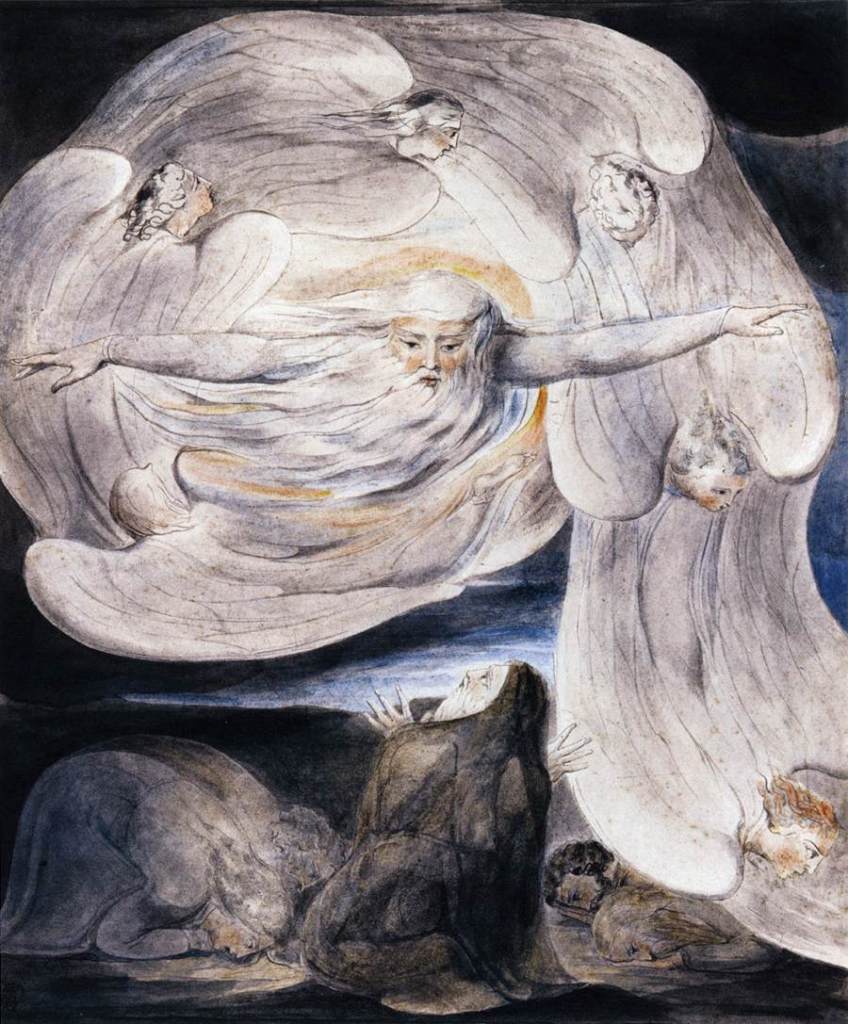
(art: God Answering Job from the Whirlwind, William Blake, 1805 to 1806)
Acceptance of a hurtful event or transgression is so important for forgiveness that it can be truly be said that forgiveness is not possible without acceptance. In the forgiveness process, acceptance in terms of “yes, this is what really happened,” is involved in clearly and fully recalling a hurtful event in all of its dimensions and impacts in your life, whether as part of the REACH Forgiveness Process or the Guideposts for Forgiving process. Acceptance is also the essence of finding empathy for the person who committed the hurtful act, in terms of acknowledging that the act of the person came from causes that could probably cause us to act in the same way. This empathy is validated by scientific research to be a crucial component of an effective forgiveness process — you can’t do it without it. Acceptance is then also involved in seeing the essential sameness of that person with ourselves. Both clear and full remembrance of the hurtful event, and finding empathy for the transgressor, are absolutely essential elements of any forgiveness process if it is to result in a full and lasting forgiveness.
Often the term “acceptance” is quickly associated with what amounts to excuse, or dismissing an injustice. In a forgiveness process, it is important to realize that acceptance does not excuse or ignore the injustice involved in a hurtful event. Acceptance also does not close the injustice gap that happens in a hurtful event: the gap between what a person is worthy of, deserves, or what is rightfully theirs, and what happened to them in the hurtful event. Rather, acceptance in a forgiveness process means directly engaging with the reality of the hurtful event, and the people involved, including yourself. In this way, acceptance is the opposite of the denial, avoidance, minimalization, and rationalization that we can use in order to not engage with the reality of a hurtful event, its impact in our lives, who was involved and why.
The morning prayer (lauds) in the Liturgy of the Hours for today includes a reading from the Book of Job that speaks to the importance of acceptance. The Book of Job recounts how Job had his property stolen and his workers murdered or burnt alive by fire from the sky, and his children killed in the collapse of a house. Job is definitely challenged to accept the reality of this terrible news, and the Book of Job recounts his response (Job 1:21):
Naked I came forth from my mother’s womb, and naked I shall go back again. The Lord gave and the Lord has taken away; blessed be the name of the Lord! We accept good things from God and should we not accept evil?
The wisdom in Job’s response includes acknowledging that we are all passing through this world, essentially impermanent and ultimately without real or eternal possession of anything else other than ourselves. Job’s words also point to the essential experience of life with its comings and goings of events, people, and situations. In his General Audience and catechesis today, Pope Leo XIV explained that the goings, the suffering, losses, and failures that we experience are actually a preview of death, and ultimately unavoidable in that way — as Saint Francis sings, “nullu homo vivente po skampare” (“no living man can escape”). Although we do not prefer the end or loss of the events, people and situations that we like, they really do make life worth it all and so we have reason to say, “blessed be the name of the Lord” in gratitude. The final line pulls it all together and asks why we would accept the reality of the good things in our lives but not the bad things, including hardships and hurts inflicted on us by other people and forces that God seems to allow? The lesson seems to be that we cannot accept some parts of our life realities but not others. Life is a whole, with integrity — a real “package deal.” If we try to separate our one life into parts that we accept because we like that they happened to us, and parts that we don’t accept because we don’t like that they happened to us, we no longer have our whole life. In fact, what we’ve done is reduced ourselves to a partial life, where even the things that we like to have happen to us are reduced in value because we chose to no longer contrast them with the hurts, hardships and losses that are also part of life, but which we do not accept. As Pope Leo XIV stated in his General Audience and catechesis today:
Hour by hour, we have so many different experiences: pain, suffering, sadness, intertwined with joy, wonder, serenity. But through every situation, the human heart longs for fullness, a profound happiness.
Let’s review the main points we can take away from Job:
- Our earthly life is temporary.
- Our earthly life will end and all the property and possessions we may acquire won’t change the ultimate reality of death or go with us.
- Normal human life includes a lot of events, people, and situations that show up and also go away.
- The good events, people, and situations that show up are so good, even though they also go away or are taken from us, as to make all of life worth living with gratitude.
- A whole human life has to include events, people, and situations that we like, and ones that we don’t like — trying to separate out one from the other makes life no longer whole, but only a partial life.
- The wisest way to understand life and to life it fully, is to see that we need to accept both the events, people, and situations that we like, and the ones that we don’t like.
Let’s add two more points to that list that pulls it together for forgiveness…
- Acceptance of the hurtful events, people, and situations in our life is possible for forgiveness, and is possible through forgiveness.
- Forgiveness restores us to a full whole life through the involved acceptance of hurtful events, people, and situations that we forgive.
In his General Audience today, Pope Leo XIV observed “our seemingly chaotic lives, [are] marked by events that often appear confusing, unacceptable, incomprehensible: evil in its many forms, suffering, death, events that affect each and every one of us.” Pope Leo explains that finding the acceptability of these events in our lives can be aided by “meditating on the mystery of the Resurrection” so that “we find an answer to our thirst for meaning.” He adds. “We need to savour and meditate on the joy after the pain, to retrace in the new light…” This can be understood as the true “Way of the Cross” (or Via Crucis) in which we accept hurtful events, people and situations in our lives, because we have faith that doing so is part of getting to a new life, a life that is fully luminous — the Way of Light (or Via Lucis). This process is not only symbolized in the Crucifixion and Resurrection (both together, not separate from each other) of Jesus Christ, but is real in a way that extends that reality to include all of us, and all of the hurtful events, people, and situations in our lives.
The Liturgy of the Word for today includes a reading from the Gospel of Luke (14:25-33). Jesus teaches:
Whoever does not carry his own cross and come after me cannot be my disciple.
With our understanding of the Way of the Cross also being the Way of Light, we can see that what Jesus is saying is that carrying your cross – the hurtful events, people, and situations in your life – is actually the way to of getting to a new life, a life that is fully luminous. This is so important to understand that Jesus says we’re not really learners (the original meaning of “disciples”) if we’re not understanding and putting the Way of the Cross into action in our lives. It’s not just about shouldering your hurtful events, people and situations, and it’s not about excusing them, or denying them or rationalizing them. It’s about accepting them in their full reality as part of the process of forgiveness on the way to a renewed, whole, and fully luminous life, That’s important to understand and apply in our acts of forgiveness.
Please share these words with someone who needs them today.
This text is an original work of its author Tom Delaney and was entirely composed without the use of artificial intelligence (AI).
If your parish or faith community is seeking a deeper experience of forgiveness, healing, mercy, and spiritual renewal, Live and Forgive is here to help. To begin the conversation, email Live and Forgive presenter and facilitator Tom Delaney at tom@liveandforgive.com — he will be glad to connect with you for a conversation. Please type in your email and click “Subscribe” below to stay connected and get Live and Forgive articles delivered to you.
Take your learning deeper! Enter the term or word for any idea or thing you saw in this article that you want to know more about, and you will get a list of other articles that also talk about that idea or thing!
 Live and Forgive