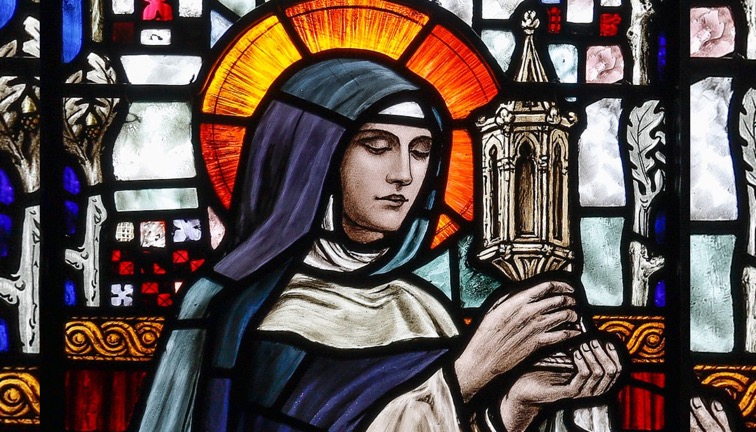
(art: Saint Clare of Assisi)
In September I wrote an article entitled The Way to Forgiveness: Quiet and Meditation that explained how quiet meditation can help move you mentally and spiritually to the place you need to be in order for you to be ready to engage with forgiveness. Our Franciscan tradition includes exemplars of meditation including, to name just a few of the many:
- St. Clare of Assisi and the four step meditation of Gaze, Consider, Contemplate, Imitate
- St. Francis of Assisi and meditation on God and creation in the Canticle of the Creatures
- Francisco de Osuna and the Third Spiritual Alphabet, which inspired St. Teresa of Avila
- Padre Pio and his counsel on meditation, prayer, and devotions
New scientific research published in the premier scientific journal Nature, entitled Neural and Molecular Changes During a Mind-Body Reconceptualization, Meditation, and Open Label Placebo Healing Intervention, provides more evidence of the positive effects of meditation. The researchers found that meditation engaged natural physiological pathways that promote neuroplasticity (growth of connections in the brain), metabolism, immunity, and pain relief. Neuroscience News listed the findings in detail:
- Brain network changes: Meditation during the retreat reduced activity in parts of the brain associated with mental chatter, making brain function more efficient overall.
- Enhanced neuroplasticity: When applied to laboratory-grown neurons, blood plasma from post-retreat participants made brain cells grow longer branches and form new connections.
- Metabolic shifts: Cells treated with post-retreat plasma showed an increase in glycolytic (sugar-burning) metabolism, indicating a more flexible and adaptive metabolic state.
- Natural pain relief: Blood levels of endogenous opioids – the body’s natural painkillers – increased after the retreat, indicating that the body’s natural pain-relief systems were activated.
- Immune activation: Meditation increased inflammatory and anti-inflammatory immune signals simultaneously, suggesting a complex, adaptive immune response rather than a simple suppression or activation.
- Gene and molecular signaling changes: Small RNA and gene activity in blood shifted after the retreat, particularly in pathways related to brain function.
Study participants also self-reported experiences characterized by profound feelings of unity, transcendence, and a new and different awareness. These experiences were positively associated with greater biological changes, including greater integration of brain activity across different regions. The improved neuroplasticity and immune system activation suggests meditation has the potential to promote mental health, emotional regulation, stress resilience, and even chronic pain management.
In a statement shared by Neuroscience News, researcher Alex Jinich-Diamant explains:
This study shows that our minds and bodies are deeply interconnected — what we believe, how we focus our attention, and the practices we participate in can leave measurable fingerprints on our biology. It’s an exciting step toward understanding how conscious experience and physical health are intertwined, and how we might harness that connection to promote well-being in new ways.
In the Catholic Church, we are truly fortunate to have traditions of meditation handed down to us from saints and great scholars of spirituality. Still, too often people are unaware that the Catholic Church has these traditions of meditation, and think only of traditions in other religious systems or popular culture. I wish people knew that if they want to learn about real and time-tested meditation they don’t need yoga pants or a ticket to India — they just need to go to their closest Catholic Church!
The Catechism of the Catholic Church lists that we have a variety and multitude of objects and aids for meditation: “…sacred Scriptures, particularly the Gospels, holy icons, liturgical texts of the day or seasons, writings of the spiritual fathers, works of spirituality, the great book of creation, and that of history — the page on which the ‘today’ of God is written” (para. 2705). The Catechism explains, “There are as many ad varied methods of meditation as there are spiritual masters” (para. 2707). In addition, the Catechism counsels us, “Christians owe it to themselves to develop the desire to meditate regularly…” and adds:
Meditation engages thought, imagination, emotion and desire. This mobilization of faculties is necessary in order to deepen our convictions of faith, prompt the conversion of our heart, and strengthen our will to follow Christ.

Meditation can give us the mental and spiritual nourishment that we need in order to enter into forgiveness. Paraphrasing Franciscan mystic Francisco de Osuna’s words, “Let us pray to the Lord Jesus Christ that working in silence [meditation] we may eat our own bread.” We know from the Lord’s Prayer that we ask for this nourishment, so that next we may ask for forgiveness, as we commit to forgiving others. Bread and forgiveness are literally in one and the same sentence in the words taught to us by Jesus Christ himself:
Give us this day our daily bread,
and forgive us our trespasses,
as we forgive those who trespass against us.
I can shorten those points of the Lord’s Prayer to a simple and memorable phrase: Live and forgive.
Please share these words with someone who needs them today.
This text is an original work of its author Tom Delaney and was entirely composed without the use of artificial intelligence (AI).
If your parish or faith community is seeking a deeper experience of forgiveness, healing, mercy, and spiritual renewal, Live and Forgive is here to help. To begin the conversation, email Live and Forgive presenter and facilitator Tom Delaney at tom@liveandforgive.com — he will be glad to connect with you for a conversation. Please type in your email and click “Subscribe” below to stay connected and get Live and Forgive articles delivered to you.
Take your learning deeper! Enter the term or word for any idea or thing you saw in this article that you want to know more about, and you will get a list of other articles that also talk about that idea or thing!
 Live and Forgive