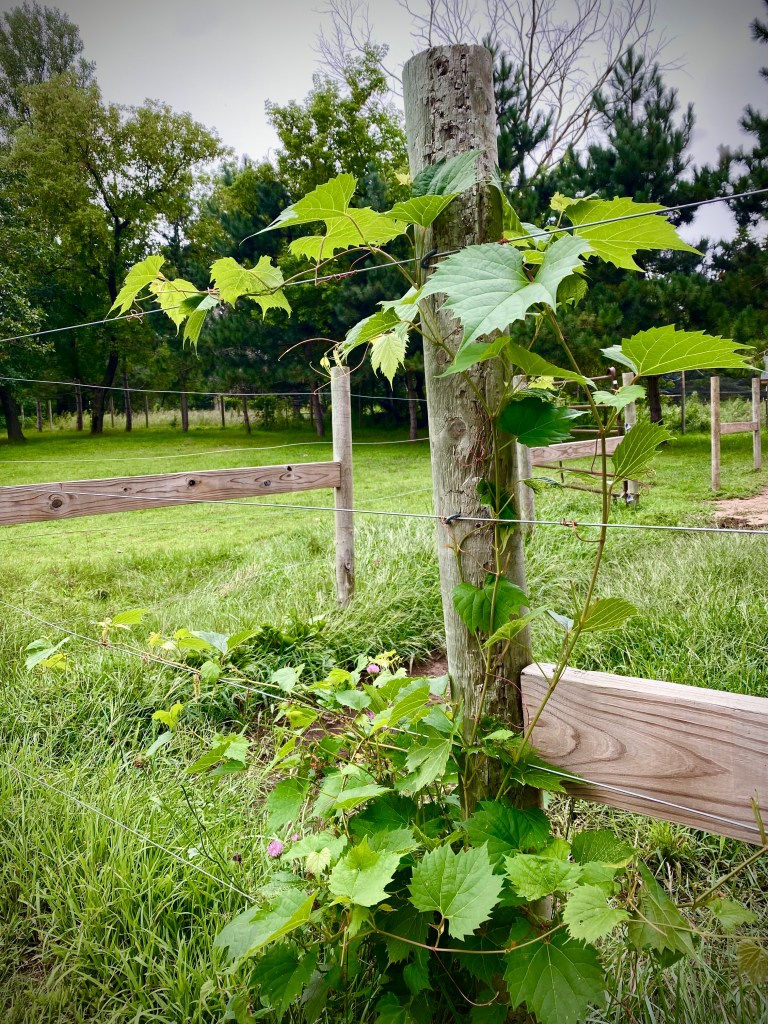
(photo by Tom Delaney, Sherburne County, Minnesota 2025)
Wild grapes frequently show up on the borders of pastures here on the oak savanna of Central Minnesota. This year I made a point to help them grow by doing some vine dressing and using the fence around the north pasture as a scaffold of sorts. More properly they are Riverbank Grapes (Vitis riparia), and earn their name because of their preference for living on the edge…literally, as in the edge of forests, the edge of riverbanks, and any place where there is a transition in the vegetation that will allow it to grab a spot that gets plenty of sunlight. I suppose there could be an analogy and insight there for understanding people who seem to always be grabbing a spot on the edge. Maybe that is their way of finding some openness and access to the light needed for life and growth. It’s very natural in that way.
Today let’s take a look at something St. Francis of Assisi wrote in his Praises. This is a selection of St. Francis’ expansion of the Lord’s Prayer, in which he added his own thoughts and insights into each line. In terms of Franciscan spirituality, it is an important communication from St. Francis himself of his personal take on each line of what is one of the the most important instructions and prayers of Jesus Christ in the Gospels. Forgiveness is a very important topic and principle throughout the Gospels, including in the Lord’s Prayer, and so we naturally find St. Francis sharing his thoughts on forgiveness.
Specifically, St. Francis took the line in the Lord’s Prayer concerning “…and forgive us our trespasses…” as an opportunity to offer an understanding of divine forgiveness. In doing so, he brings in an important and frequently misunderstood principle of Catholic faith: intercession. Here is what St. Francis wrote in his Praises:
And forgive us our trespasses, by Thy mercy in virtue of the Passion of thy Beloved Son, our Lord Jesus Christ, and through the intercession of the Most Blessed Virgin Mary and of all Thy saints.
St. Francis of Assisi helps us understand that there is divine mercy and forgiveness, and points to the crucifixion of Jesus Christ, the Son of God, as the source and cause of divine mercy and forgiveness. Next St. Francis brings in the intercession of Mary (Mother of God) and the saints as an additional cause for divine mercy and forgiveness. Intercession of Mary and the saints is a very central belief of the Catholic Church that often gets misinterpreted as worship of Mary and saints and scandalous by people who are not Catholic and very understandably don’t get it. The Catechism of the Catholic Church explains intercession, but would we expect someone who is not Catholic to look up something in the Catechism?
Paragraph 956 of the Catechism of the Catholic Church explains why intercession of the saints is part of Catholic faith and provides two quotes from actual saints that demonstrate the idea:
“Being more closely united to Christ, those who dwell in heaven fix the whole Church more firmly in holiness. . . . [T]hey do not cease to intercede with the Father for us, as they proffer the merits which they acquired on earth through the one mediator between God and men, Christ Jesus. . . . So by their fraternal concern is our weakness greatly helped.”
Do not weep, for I shall be more useful to you after my death and I shall help you then more effectively than during my life. [quote of St. Dominic as he was dying]
I want to spend my heaven in doing good on earth. [quote of St. Therese of Lisieux in her final conversation]
The main gist is that the saints are helpers who happen, by virtue of their holiness and closeness with God, to be in a very good position to be both examples to us in improving our own relationship to God, and even serve as something of a support and bridge in our relationship to God. Especially see that word “fraternal,” which means that the saints are sincerely concerned and caring about how the rest of us are doing — not in a casual way, or a close way, but in a truly familial brother and sister kind of way. Did you know that your family includes saints and is THAT BIG?
I think the main lesson that understanding intercession has to offer regarding forgiveness is that you never have to go it alone. Anything having to do with healing, recovery, and resilience is a very hard road if you have to walk it alone. As a matter of fact, one of the simplest and best ways to improve your chances of healing, recovery and resilience is to get with a friend and companion and bring them with you: to appointments, to meetings, to treatments, to anything that shows up as part of your journey. So far I have been talking about a “physical” friend and companion, but the point of intercession is to make sure you know that you can also bring along as many saints as your friends and companions as you want to, and that they saints WANT TO DO THAT FOR YOU! So just ask!
Some people working a forgiveness process, like the REACH Forgiveness Process that Live and Forgive presents, may find it helpful to carry with them a reminder of their saintly friend and companion. Many of the saints have symbolic connections to natural objects — e.g. acorns and St. Brigid of Kildare. There are also plenty of medals, charms, and pendants stamped with a likeness of a saint and a short prayer that you can pick up for yourself. There is nothing wrong with deciding on your own memento for your saintly friend and companion, including creating it yourself. Things like that are very personal and can be the best reminders of all.
P.S. I completed my training in forgiveness education and the REACH Forgiveness Process in the Human Flourishing Program at Harvard University. The Human Flourishing Program is in the process of developing resources that faith leaders can use for guided discussions and experience of divine forgiveness. You can watch an informative video from the Human Flourishing Program entitled Experiencing Divine Forgiveness: Empirical Insights and Practical Implications.
This text is an original work of its author Tom Delaney and was entirely composed without the use of artificial intelligence (AI).
If your parish or faith community is seeking a deeper experience of healing, mercy, and spiritual renewal, Live and Forgive is here to help. To begin the conversation, email Live and Forgive presenter and facilitator Tom Delaney at tom@liveandforgive.com—Tom will be glad to connect with you in a spirit of welcome, respect, and shared faith.
 Live and Forgive