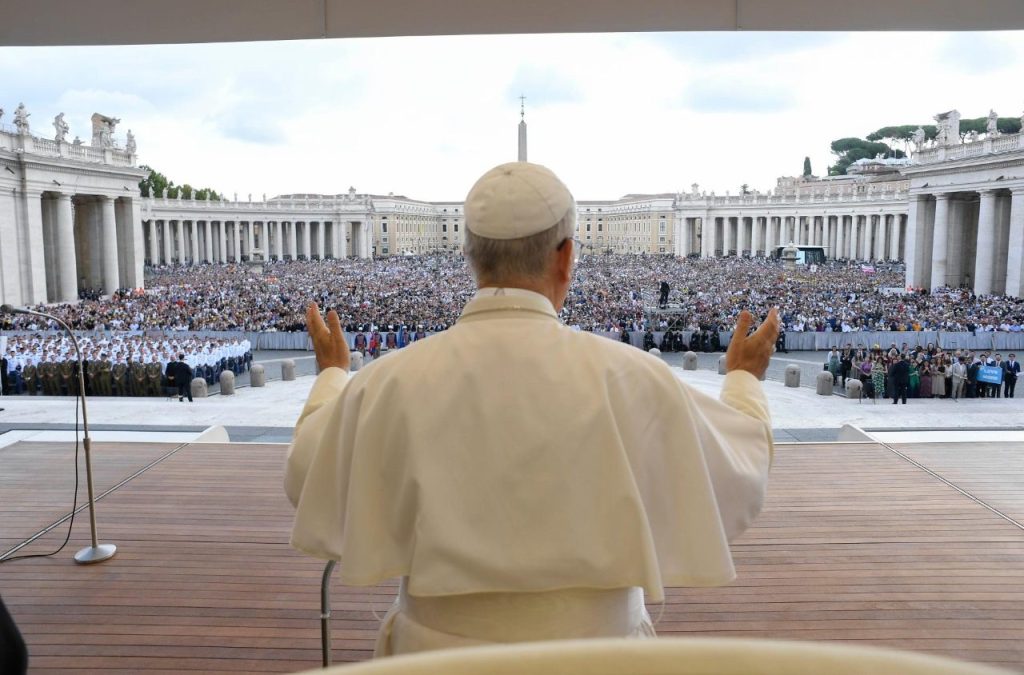
(photo: Vatican Media, September 24, 2025)
Pope Leo XIV addressed the topic of divine redemption today in his general audience. Divine redemption is an important concept and principle linked to divine forgiveness – i.e. forgiveness of our transgressions by God. Divine forgiveness is an important topic within forgiveness research because many people in general are concerned about it in their daily lives. Science can be applied to learn some things about how divine forgiveness, even if only perceived, involves factors and involves a process, and has important impacts on quality of life in terms of several indicators of psychosocial well-being and psychological distress. My intention for Live and Forgive is to draw the connections between our Catholic faith and what science affirms about forgiveness, and divine forgiveness is certainly a topic where these connections can be made.
I started Live and Forgive while completing a program in forgiveness education and forgiveness group facilitation in the Human Flourishing Program at Harvard University, and still receive ongoing support from the Human Flourishing Program. Dr. Tyler VanderWeele is the director of the Human Flourishing Program. Tyler VanderWeele and colleagues have researched divine forgiveness using a definition of divine forgiveness as “that which restores a person and brings him or her into renewed relationship with God/higher power” (VanderWeele, et al, 2020). VanderWeele and colleagues found that perception of divine forgiveness has a positive relationship of “more gets you more” to higher levels of psychological well-being and lower psychological distress. The researchers also noted an important relationship between divine forgiveness and self-forgiveness, in which “genuine reception of and faith in divine forgiveness inescapably requires a person to forgive themselves.” As part of their research, VanderWeele and colleagues provide a short summary of studies and findings related to this relationship of divine forgiveness and self-forgiveness:
- One’s sense of being forgiven by a higher power is related to increased self-forgiveness (Hall and Fincham, 2008; McConnell and Dixon, 2012).
- Divine forgiveness may moderate the relationship between self-forgiveness and psychological distress (Fincham and May, 2019).
- Divine forgiveness is positively associated with both self-forgiveness and forgiveness of others (Chen et al., 2018).
In our Catholic faith, the Catechism of the Catholic Church teaches us that that there is divine forgiveness, and that divine forgiveness is the outcome of our redemption through Jesus Christ, and specifically his self-sacrifice in the crucifixion. There are a lot of paragraphs in the Catechism related to these points, but for today I’ll just point to two of them that I think make the point most directly and explicitly.
First, Paragraph 615 of the Catechism of the Catholic Church provides an explanation of the human situation, which finds us having committed transgressions that constitute disobedience to God. Regarding “disobedience” it is important to understand the word in terms of its original meaning “to listen” and of taking guidance. Disobedience here can be understood in the simplest terms of failure to follow through on the greatest commandments, i.e. to love God and to love your fellow human beings — “the whole of the law” (Matthew 22:36-40). In essence, disobedience always involves a failure to love somehow — and I think that’s important for a fundamental understanding of what we’re talking about. The final sentence of Paragraph 615 is good news, explaining that “Jesus atoned for our faults and made satisfaction for our sins to the Father.” The meaning of that sentence is that Jesus Christ stepped into our human situation of accumulated failures to love, with greatest act of love, and balanced out the moral debt involved. Like when payment on a debt, coupon, or promissory note is made, that’s understood as the act of redeeming it, and is called “redemption.”
The Catechism of the Catholic Church also teaches us that divine redemption is what makes divine forgiveness possible, and that divine forgiveness is what makes reconciliation with God possible (e.g. paragraph 1462). The Sacrament of Reconciliation is the action in which divine forgiveness happens as a result (or “fruit”) of divine redemption. I would point to Paragraph 1470 for the best summary of what’s involved: we’re all on a journey, our situation is that we have transgressed in ways that are disobedient to God and failures to love, and by the redemptive “Paschal strength of Christ” we may receive divine forgiveness and be “strengthened for the pilgrimage and renewed” in order to continue our way.
One important thing about the Catechism of the Catholic Church that I also want to point out, is how it presents the positive effects of divine redemption, forgiveness and reconciliation, that are beginning to be confirmed by science! As contemporary scientific research informs us that divine forgiveness is experienced as increased psychosocial well-being and decreased psychological distress, Paragraph 1462 of the Catechism also observes that people experience the sacrament of Penance (Reconciliation) as “peace and serenity of conscience with strong spiritual consolation” and even a “spiritual resurrection” with “restoration of the dignity and blessings of the life of the children of God, of which the most precious is friendship with God.” What the Catechism poses as faith, science is confirming!
I will share with you the main points of Pope Leo‘s general audience that I think relate to what we have been looking at regarding divine forgiveness:
- It is possible to “live death as a result of evil and sin…the daily hell of loneliness, shame, abandonment, and the struggle of life.”
- To “live death” may be understood as “an existential condition: that condition in which life is depleted, and pain, solitude, guilt and separation from God and others reign.”
- “Christ enters into all these dark realities to bear witness to the love of the Father. Not to judge, but to set free. Not to blame, but to save.”
- “This is the true glory of the Risen One: it is the power of love, it is solidarity with a God who does not want to save himself without us, but only with us. A God who does not rise again unless he embraces our miseries and lifts us up to a new life.”
- “No place is too far away, no heart is too closed, no tomb too tightly sealed for his love. This consoles us, this sustains us. And if at times we seem to have hit rock bottom, let us remember: that is the place from which God is able to begin a new creation. A creation made of people lifted up, hearts forgiven, tears dried.”
The word “love” has shown up as commandment to be obeyed, the omission in our failures and transgressions, and ultimately as the power by which we receive divine forgiveness and reconciliation. That tells us that love is what it’s about, and even that it all centers around a very big and very important thing that we name with a short word consisting of only four letters: just l-o-v-e. I think that hidden wisdom in this might be that love is very big, and that love is very important, and also that love can happen in even the smallest and simplest things we do. It only takes four letters to spell “love.”
This text is an original work of its author Tom Delaney and was entirely composed without the use of artificial intelligence (AI).
If your parish or faith community is seeking a deeper experience of forgiveness, healing, mercy, and spiritual renewal, Live and Forgive is here to help. To begin the conversation, email Live and Forgive presenter and facilitator Tom Delaney at tom@liveandforgive.com — he will be glad to connect with you for conversation.
 Live and Forgive