
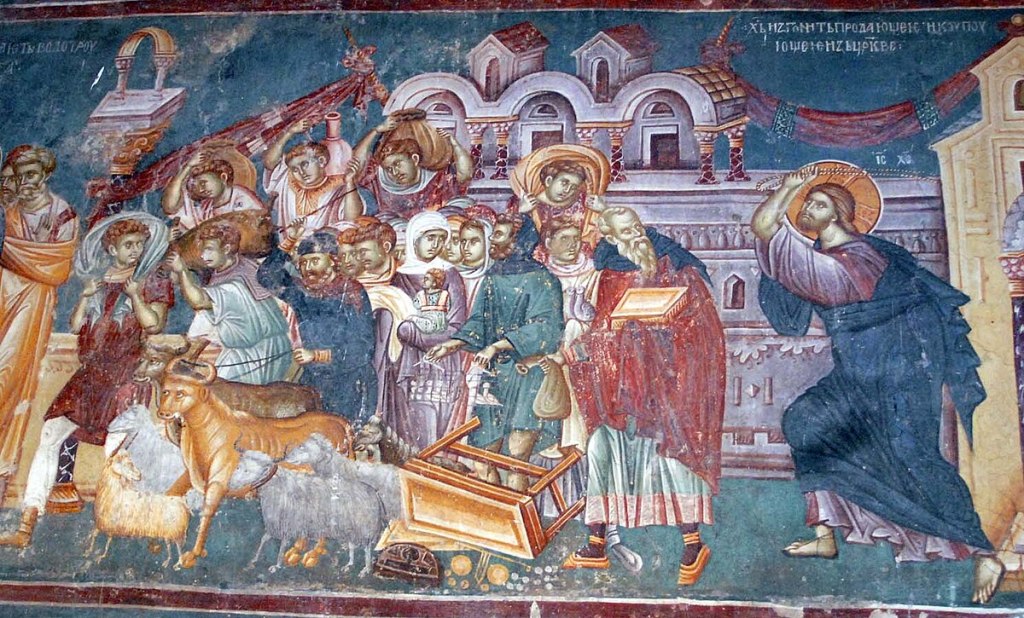
(art: Church of St. Nicetas, Macedonia, 14th cent.)
Whenever the Gospel accounts of Jesus driving out the money changers from the temple come up in the Liturgy of the Word, I often see an article or hear someone asserting that the Gospel account is proof that anger can be righteous and even a virtue. It gets to the point where you can feel that you are less virtuous if you are not angry in connection to some cause. This has always been hard for me to agree with for a few reasons reasons. My short list includes:
- The enormous amount of scientific research demonstrating that anger in any form, including long-term resentment, is deleterious to physical and mental health. That’s a sure sign that we were maybe designed to have anger for a moment, but not as an ongoing part of our lives. Our bodies and minds send us their own messages that anger is simply not good.
- The consistent teachings and examples in the Gospel that we are to have compassion, mercy, and forgiveness rather than anger in any situation or for any person, as fulfillment of our love for God and our love for our neighbor – “the whole of the law” (Matthew 22:36-40, Romans 13:8-10, Galatians 5:14).
- The examples of the martyrs and saints who teach us that grace consists in committing to and persevering in compassion, mercy, and forgiveness rather than anger. Pope Leo XIV specifically pointed to the example of Congolese martyr Blessed Isidore Bakanja in his Jubilee Audience and catechesis of November 8th. Rather than anger, “while close to death due to the abuse he suffered, Isidore declared that he would pray for his aggressors from heaven.”
Anger is an important topic when it comes to forgiveness. Effective forgiveness processes are designed to eliminate anger for past wrongs, and use empathy in a way that replaces anger with positive emotions. Forgiveness researcher Robert Enright explains why forgiveness is needed to get anger out of our lives, Here;s my encapsulation of the list:
- Anger is plain bad for our physical and mental health. It affects every organ in your body. Anger can literally make you ill.
- Anger drains us us of energy, leaving little or none for the rest of our lives, including the good things in our lives.
- Anger can impinge upon our sleep and cause sleep disturbance and dysfunction, further exhausting us of energy for life.
- Anger from a traumatic event can cause us to ruminate, repeatedly playing the incident over and over in our mind, growing in its compulsion to the point that we can’t stop thinking about the event or offender.
- Anger can become so part of our lives that it becomes habitual, and even part of our daily rituals, and deepens its negative hold and control on us in our thoughts, feelings, and actions.
- Anger tends to create more of itself, growing in its depth and reach over time to creep into how we see ourselves, the quality of our interpersonal relationships, and our view of the world.
Everything I am about to propose is just my own thinking and pondering — just me. That said, I think the question of whether anger can be righteous and virtuous is important. Especially when the Gospel account of Jesus in the temple with the moneymakers comes up, I think there are things to … um … think about. Yes, now we’re going to be thinking about thinking. Stick with me, let’s try it together!
Read word for word, we can see that the Gospel accounts of Jesus and the money changers nowhere state that Jesus was angry, furious, or in a rage (John 2:13-25, Matthew 21:12-17, Mark 11:15-19, and Luke 19:45-48). The idea that Jesus was angry during this episode is an inference that we make based on the written account of Jesus’ behavior and our own life experience — and it is just an inference. By the way, none of the Gospel accounts of the incident include Jesus striking anyone with a whip. Should we be open to the possibility that Jesus was actually calm, focused, and methodical during the incident, and only brandished the whip? Perhaps he was simply stern and used a prop in admonishing, “My house shall be a house of prayer.” Why not? We can imagine bouncers calmly and methodically removing people from bars, but we can’t ponder that Jesus was the same in his demeanor?
If we want to remain convinced that Jesus was angry in the temple, then it may be worth considering that we see a pattern in Jesus’ actions throughout the Gospel: Jesus always speaks and acts toward a person in the exact way that they need him to in order to have a potentially transformative encounter. In every episode and every encounter with Jesus recorded throughout the Gospel. you always see Jesus custom tailoring his responses to people based on who the person is and how that person needs to hear Jesus. Doing that requires an absolutely sublime level of insight and wisdom into how each person is a lock that needs a precision-engineered key to open up to an opportunity for transformation. With regard to the money changers, this point of view has us see Jesus’ actions as delivering to the money changers the response that they needed in order to have a potentially transformative experience of God’s grace. It’s possible that no other response would have worked. No other approach would have worked! Approached too softly, the money changers would not have been impressed or even attentive. They themselves needed Jesus to show up with a little dose of fury so that their day, their minds, and potentially their lives, could be changed. And as he always did, Jesus gave them what they needed.
A last consideration I would pose is the importance of remembering that Jesus often does things in the Gospel accounts that are only possible for us to do if we have a mountain of grace … and even then it may be a stretch for any one of us (especially me). With regard to the money changers, maybe Jesus did use anger in a gracious and revelatory way. That doesn’t mean that we too have an automatic ability to be angry in a gracious and revelatory way. We’re just not that good at it! We could be very far from that level of grace in understanding and using our own anger. As a matter of fact, we probably just are that far away. Hopefully we can have the humility to acknowledge that as much as Jesus is an expert and master in gracious anger, we’re simply not and should avoid thinking our anger is the right solution for any situation. That kind of thinking is just dangerous thinking that has a high probability of ending badly. We cook on stove tops but we also make sure little kids don’t touch hot burners or turn them on, or even touch the stove knobs. As a matter of fact, we work attentively to keep them totally away from the stove, and a lot of kids figure out on their own that the oven is not for them. Is it any more complicated for us to understand that we should keep away from anger?
A final possibility that someone could pose is that Jesus really did “lose it” in the temple, was actually angry, in the way that all of us so often are in situations. When we remember the “fully divine, fully human” principle in the Catechism of the Catholic Church (paragraphs 464-470), maybe the incident with the money changers is indicative that Jesus really is fully human, and in that sense very human, just like all of us, and “got real angry” in the temple. If we also believe that Jesus was incapable of a mistake, we make our way to thinking that the anger was not a mistake. If we believe the principal that everything Jesus did is exemplary, and ought to be imitated by us, then we land on correct and exemplary anger as a possibility … including making whips to use on people. In response to this, I still find myself thinking that Jesus may have had the same feelings of anger that I am certainly capable of having, but managed them in a way that I am probably not as good at. Therefore, no whip making for me today.
Even if we think the episode with the money changers may be exemplary, let’s think about it with more intentionality: Exemplary of what? The anger? Is that the insight and revelation of the Gospel account? Or is it actually the consistent quotation of Jesus across the Gospel accounts: “My house shall be a house of prayer, but you have made it a den of thieves.” If that’s the case, then the point is not anger in any way, but rather it’s an important point about desecration of the sacred for monetary gain. That is the central point and to think it’s anything else is a mistake on our part.
We may be making a big mistake when we try to use the Gospel account of the incident with the money changers as a rationale for anger. We don’t know for sure that Jesus was angry, or that even if he was, that it is supposed to be exemplary for us. I have to point out that the Gospel account of the incident with the money changers is very short, and doesn’t recount the incident with the money changers for purposes of Jesus intentionally teaching his disciples. As far as actual teachings of Jesus, we have to look at those other Gospel accounts where Jesus is purposively teaching his disciples. When we do that, we are immersed in teachings of compassion, mercy, forgiveness, and love. The teachings are repetitive, overlapping, consistent, compelling, and even urgent for us. An idea of righteous anger disappears into the depths of these teachings like a nail tossed into the sea.
You probably already know where I land on all of this. Be careful with anger. Perhaps it is truly best to avoid it because of its dangers. Dedicating ourselves instead to compassion, mercy, forgiveness and love is a surer path — so take it today.
Please share these words with someone who needs them today.
This text is an original work of its author Tom Delaney and was entirely composed without the use of artificial intelligence (AI).
If your parish or faith community is seeking a deeper experience of forgiveness, healing, mercy, and spiritual renewal, Live and Forgive is here to help. To begin the conversation, email Live and Forgive presenter and facilitator Tom Delaney at tom@liveandforgive.com — he will be glad to connect with you for a conversation. Please type in your email and click “Subscribe” below to stay connected and get Live and Forgive articles delivered to you.
Take your learning deeper! Enter the term or word for any idea or thing you saw in this article that you want to know more about, and you will get a list of other articles that also talk about that idea or thing!


Leave a Reply