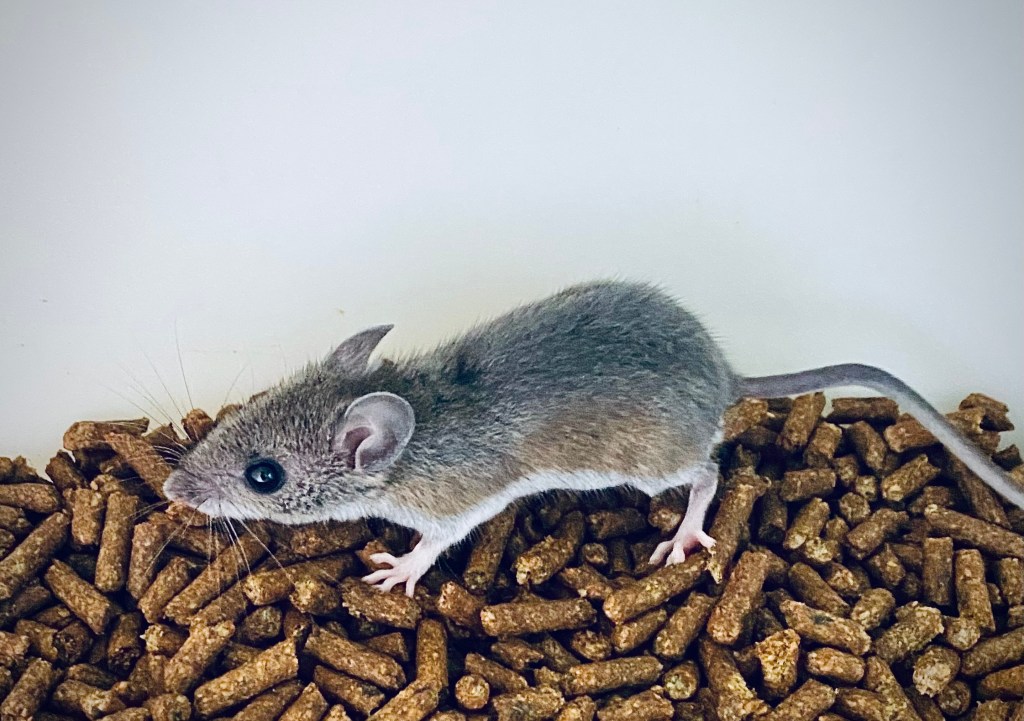
(photo: Prairie Deer Mouse by Tom Delaney, Sherburne County, Minnesota, 2025)
An important part of my day is the time I spend in our stable, hay shed, and on our pastures. Regularly doing some outdoor work caring for animals and little ecosystems like pastures, keeps gives me a daily connection to nature and the proverbial “something bigger than myself.” I also have to say that over time, you start seeing some “regulars” and make a number of feral animal friends that you didn’t have before. For example, on most days around the time of dusk, I have a visit with a rabbit whom I have named Francis. We have gotten pretty used to each other as Francis knows I’m just out there to do manure management, which includes carting the manure across the north pasture to the compost bins on the west side. Not too long ago I started my morning chores in our stable and found a mouse swimming for his life in the water barrel. The poor thing was swimming in circles around the perimeter of the barrel looking for a foothold to get out. I couldn’t help but wonder if the mouse had been doing that all night and was in pretty rough shape now in the morning — I know I would be! So I just reached in there and made a ledge for my hand that the mouse could cling too and gave it a lift out of the barrel and back onto solid land. When the mouse hit the ground, it it quickly made its way to the hay shed it probably calls home.
I do not know if the mouse in the photo is the same mouse, but the story goes like this…
One night I left the cover off the horse feed barrel…again. It’s a great barrel and even though my neighbors said that it wouldn’t be able to keep mice out of the feed, it actually has never failed, that is, as long as I remember to put the lid back on. I am getting to an age in life where my mind is (shall we say) less attached to memories and much more free wheeling. Sooo…a couple of nights ago I was not attached to the memory of the feed barrel lid and left it off. When I came back in the morning, there was a very well fed Prairie Deer Mouse (Peromyscus maniculatus) stuck in the grain barrel. Unlike the water barrel escapade, I imagine this mouse had a relatively comfortable evening in grain barrel seemingly surrounded by a mythical prosperity of grain pellets. I hated to bring a close to this fantasy become real life, but I figured I have a place in this world, the Prairie Deer Mouse has a place in is world — and in the grain barrel ain’t it. That all said…there is some pretty good likelihood that my involuntarily cultivated detachment toward worldly things will again cause me to forget the grain barrel lid again. It’s only a matter of time as far as the mouse is concerned.
The morning prayer (Lauds) in the Liturgy of the Hours for today includes a reading from a letter by the apostle Paul addressed to the Ephesians (4:29-32):
Never let evil talk pass your lips. say only the good things people need to hear, things that will really help them. Do nothing that will sadden the Holy Spirit with whom you were sealed against the day of redemption. Get rid of all bitterness, all passion and anger, harsh words, slander, and malice of every kind. In place of these be kind to one another, compassionate, and mutually forgiving, just as God has forgiven you in Christ.
When we are offended or hurt by someone, it is a natural and healthy response to feel an aversion, annoyance, or even anger toward transgressor. These feelings help us recognize that the situation is hurtful to us, and energizes us to take control of the situation or exit it as soon as possible, so as to head-off any more hurt. The problems start when that aversion, annoyance, and anger sticks around in our mind too long, and and turns into long-term bitterness and resentment — changing us into people who are bitter and resentful. Being that way is not our best self, and can become a very serious obstacle to our own sense of purpose in life, personal growth, and becoming the best person that we are meant to be. Paul knows this, and even describes that when we get stuck in resentment and bitterness, it saddens God in the person of the Holy Spirit. When you love and care for someone very deeply, you do feel sad when you see that person taken over by negative feelings. You are sad because there’s a tragic loss when that happens to somebody, and that makes for a natural kind of grieving.
Paul has the wisdom to point to two solutions for bitterness and resentment:
Use your words to change your mind. When you say positive things, your mind participates in that and starts writing the positive ideas that are in those words into the mind’s script — the script that the mind uses for responding to future experiences and situations. Over time they become your working ideas for your day-to-day experiences. Positive thoughts build positive feelings and positive actions that prevent you from falling into the bitterness and resentment trap.
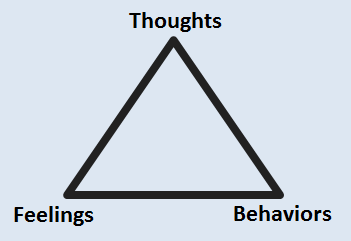
(source: Assigana, E., et al., TF-CBT Triangle of Life, 2014)
Say things that will help people, especially when they are the wrongdoer. I propose to you that people are more likely to hurt someone else when any one or a combination of tough things is happening for them in their life situation:
- They feel overwhelmed and don’t see another way of handling things.
- They don’t know or feel that their actions have impacts on other people.
- They lack the personal experiences or mental skills needed to see that positive social behavior makes a better world for them and everyone else too.
- They feel that they themselves are not capable or worthy of being loved and never could be
- The only ways they have to handle life are dysfunctional ways that they from someone else who was dysfunctional too, often during childhood.
In each and every one of those listed circumstances, the person would probably not hurt or offend someone else if they could just get some help to overcome their obstacles. When a person can’t do that for themselves, they simply must get help from someone else, and we have to be that someone else if there is to be any hope for the situation. As Paul points out, help usually starts with saying something that the person needs to hear, followed by saying things that will help them. Telling someone that they are worthless and rotten and couldn’t be anything else but worthless and rotten will never help that person. Even just thinking that about a person doesn’t help them … or us!
Replace negative feelings toward people with feelings of kindness and compassion. To be human is to have feelings — we just have to have them or we’re not being human. When we want to clear out negative feelings, we can’t just do it by making ourselves into people with no feelings at all (or at least we shouldn’t because that creates more problems than it solves). Feelings just have to be there inside of us, and the smart way to manage feelings – that you have to have anyway – is to move out negative feelings by replacing them with positive feelings. This can be a very challenging thing to do when we have been hurt and are still feeling the bitterness and resentment from that, but Paul wisely points out that the tool to get the job done is compassion, or what we may also call empathy. Empathy is the process of coming to know and understand more about the transgressor’s life situation and circumstances, and:
- Realizing that we may have had the same experiences and understand the power they can have over us.
- Realizing that we share a same basic humanity with the transgressor, and that it is possible we would have done the same thing in the transgressor’s situation.
When empathy brings us to those understandings, it opens the door to the possibility of full and lasting forgiveness. More about that soon!
Forgiveness is a “what goes around, comes around” deal. I think we all could agree that we live in a cause-and-effect world. Things make things happen, and those things make more things happen, and it’s all really the way everything happens — that’s what we know as reality. The more you can see and understand cause-and-effect in all things, the more you can start to see that we participate in it, and that it is always at work in our lives. Not only do we participate in it, but we also have the amazing human ability to use cause-and-effect in ways that will make us the best possible human being we can be. Forgiveness is a very powerful way to use cause-and-effect in a way that makes the life of the forgiving person better. When it is done right, the positive feelings of forgiveness are so good that the forgiving person feels like forgiving again, and again! If the forgiveness involves telling a transgressor how what they did was wrong and impactful, maybe understandable given their life circumstances. and yet they are a human being capable of doing much better and that they will if they can get the help they need, there can also be a release and consolation for that person as well. Never underestimate the impact for the forgiven person, and the possibility that it will change their life in ways that make them a forgiving person as well, and with the good feelings and thoughts that come with being a forgiving person: the forgiven become the forgiving! When we choose to use forgiveness, we start an unfolding process that puts forgiveness into wider circulation within ourselves and also within the larger world. Over time, starting with just one or a few forgiving people, it is possible to create a force of forgiveness made up of huge numbers of people. Think of it like lining up dominoes in so that one domino knocks over two dominoes, and those two and so on. That’s what can happen. Cause-and-effect at work to make a world of forgiveness. Do you feel like a domino today?
Paul’s wisdom converges with science in the REACH Forgiveness Process that can be easily taught in Live and Forgive presentations, guided retreats, small group series, and wilderness walks. A core part of the process is “emotional replacement” – replacing negative feelings with empathy and positive feelings – as the means to full and long-lasting forgiveness. The process is research-validated, yet simple and straightforward enough to do that it has been seen by Harvard University researchers to have global potential. The process recognizes and integrates that our words can lead our thoughts and feelings, and intentionally uses that thoughts-feelings-actions connection to give people reliable ways of forgiving fully and in a way that lasts. Live and Forgive is dedicated to weaving together the faith-based understanding of forgiveness with the science that both confirms and makes faith and forgiveness actionable in real life for people that need it.
“Faith and Reason are like two wings of the human spirit by which it soars to the truth.”
― Pope St. John Paul II, Fides et Ratio
This text is an original work of its author Tom Delaney and was entirely composed without the use of artificial intelligence (AI).
If your parish or faith community is seeking a deeper experience of healing, mercy, and spiritual renewal, Live and Forgive is here to help. To begin the conversation, email Live and Forgive presenter and facilitator Tom Delaney at tom@liveandforgive.com—Tom will be glad to connect with you in a spirit of welcome, respect, and shared faith.
 Live and Forgive