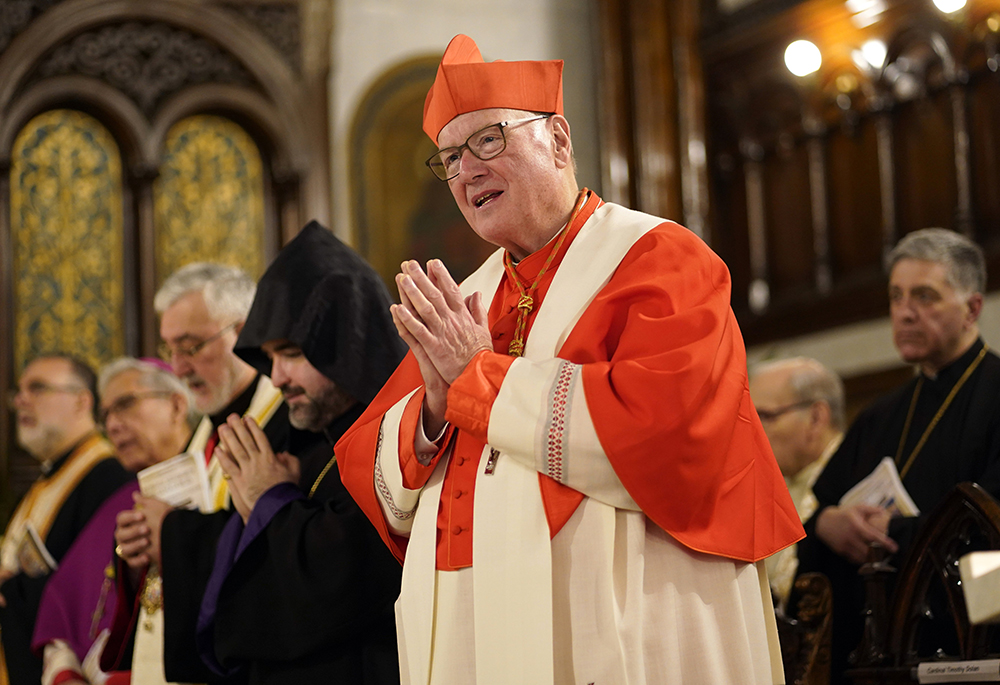
(photo: Bishop Timothy Dolan, OSV News, Gregory A. Shemitz, 2025)
Bishop Dolan is a vocal advocate for the work of the Catholic Church to promote mental health in all of its communities. He founded the International Association of Catholic Health Ministers after experiencing the suicide of his brother, and several family members before him. OSV News reports that Bishop Dolan recently addressed a convening of the Ministry of Hope Conference, a global Catholic forum on mental health held Nov. 5-7 in Rome through the Vatican’s Pontifical Academy for Life. Bishop Dolan’s address highlighted the same need and purpose of mental health education in the Catholic Church as that which Live and Forgive is designed as a response, specifically as forgiveness education that promotes mental health.
One important point Bishop Dolan made at the conference is that Catholic parishioners and community members are interested in learning about mental health and the things that contribute to mental health. I think, It is probable that the interests of parishioners and community members include learning about the things that science says promote mental health, and specifically forgiveness.
Bishop Dolan also explained at the conference, “When the Church speaks tenderly about mental health, people listen.” I think that Bishop Dolan’s explanation points to the desire of parishioners and community members to learn about mental health from their Church in a way that is sensitive, understanding, loving and benevolent. Bishop Dolan described that in the best forms of mental health education and supports through the Catholic Church, “We do not prescribe, we do not diagnose, we do not treat — we love,”
Bishop Dolan, based on his own experience in the Diocese of Phoenix (Arizona, USA), described that dioceses can establish offices for mental health ministry built upon three simple pillars: education, accompaniment, and advocacy. Bishop Dolan emphasized especially that education is important as the first step: “Before the Church can heal others, she must understand the human person as a unity of body, mind, and spirit.” I think that education applies a combination of scientific theories of learning and human development, with theories of human capabilities, self-determination, and human flourishing, all the while recognizing the person as both a whole and multidimensional in terms of wellbeing. Bishop Dolan seems also to recognize this in his statement at the conference that mental health education through the Church should be a “doctrine of human development, where psychology and theology meet in humility before the mystery of the person.”
Forgiveness education is most often designed for facilitated meetings of small groups, using educational materials like the workbooks designed for engaging with the REACH Forgiveness Process that Live and Forgive uses. In a similar way, Bishop Dolan affirmed the practical value of “well sessions” in communities, that “allow people to talk openly about grief, anxiety, and loss and to find support for loved ones living with mental-health challenges.” Forgiveness education in small groups provides participants with the scientifically validated tools to engage with forgiveness in ways that decrease depression and anxiety and promote empathy, love, and a sense of hope.
In a recent paper proposing a new paradigm for research of love entitled Love and Human Flourishing, authors VanderWeele and Lee (2025) proposed that forgiveness education is a scientifically validated practical application of current theories of love, and especially linked to building a “civilization of love” for every person, as was proposed by Saint Pope John Paul II (see my previous post A New Paradigm of Love for Understanding Human Flourishing & Forgiveness). In his recent remarks at the conference, Bishop Dolan also affirmed, “…a way of transforming sorrow into solidarity, so that every person (no matter how fragile) knows that they are seen, valued, and loved.”
The 16th century Franciscan mystic author Francisco de Osuna saw that education, in terms of always providing examples, is an important part of Catholic faith. In his classic work the Third Spiritual Alphabet, Francisco de Osuna wrote: ” We owe our hearts to God and our good examples to men [people], and we must carry out both responsibilities in all ways possible.” Forgiveness education to promote mental health rooted in Catholic faith is no exception. Today’s Liturgy of the Word is a celebration of ourselves as a dwelling place and temple of God, and in it St. Paul the Evangelist declares (1 Corinthians 3:9c-11, 16-17, paraphrased):
Brothers and sisters: You are God’s building.
Do you not know that you are the temple of God,
and that the Spirit of God dwells in you?
For the temple of God, which you are, is holy.
To reemphasize Bishop Dolan’s call for mental health education in the Church to be based deeply in love, we can also reflect upon Francisco de Osuna’s admonition in the same vein:
Brothers, let us build ourselves on love and let us thrust our roots down in love. Built like sturdy structures and rooted like trees, we will be founded on love for God that makes us the dwelling place for him and the temple in which he resides, and rooted in love for our neighbor that makes us fruitful trees, sending up protective leaves and nourishing fruit.
Those final words of Francisco de Osuna about trees can also be compared with the reading from Ezekiel 47:1-2, 8-9, 12 in today’s Liturgy of the Word describing the outflowing river from God’s temple to the world:
Along both banks of the river, fruit trees of every kind shall grow;
their leaves shall not fade, nor their fruit fail.
Every month they shall bear fresh fruit,
for they shall be watered by the flow from the sanctuary.
Their fruit shall serve for food, and their leaves for medicine.
I want to finish by sharing a meditative prayer written by Francisco de Osuna that distills what we have just reflected upon concerning the connections of forgiveness education for mental health, love of God, and our responsibility to educate our brothers and sisters in Christ in ways that increase love and grace:
O adorable friend of my soul, most beneficent goodness of all who seek you, comfort and security to my soul, deifying those devoted to you, perfect hope of my inmost being, fount of the fire of my most delightful love, my ruler and glory, you who satisfy my hungering desires, justifying justice of your loved ones, most beloved charity of Catholics, most magnanimous generosity and light of my eyes, merciful Majesty of the needy, natural nobility and all knowing knowledge, harmony that perfects my ways, precious Father and possession of the poor, most quiet repose of those who lament, refreshment and relaxation for those who labor in love, health for the saints ill with love, teacher and treasurer for those who fear like children, sanctifying will and victory for all who are tempted, life of of my life, most Christian preserver of those who preserve love for you, delectable knowledge that from your mouth to mine breathes sublime secrets, sentinel of my soul, my God, guard me with your love for I love you.
Please share these words with someone who needs them today.
This text is an original work of its author Tom Delaney and was entirely composed without the use of artificial intelligence (AI).
If your parish or faith community is seeking a deeper experience of forgiveness, healing, mercy, and spiritual renewal, Live and Forgive is here to help. To begin the conversation, email Live and Forgive presenter and facilitator Tom Delaney at tom@liveandforgive.com — he will be glad to connect with you for a conversation. Please type in your email and click “Subscribe” below to stay connected and get Live and Forgive articles delivered to you.
Take your learning deeper! Enter the term or word for any idea or thing you saw in this article that you want to know more about, and you will get a list of other articles that also talk about that idea or thing!
 Live and Forgive