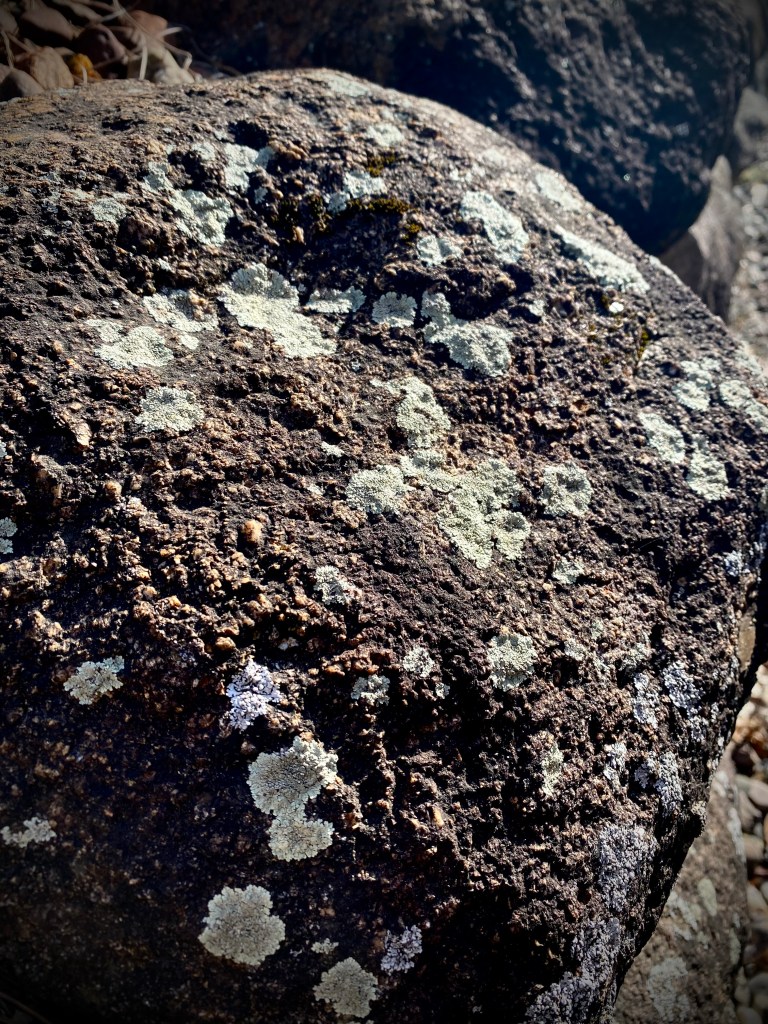
Growing up in rural Wisconsin and in Minnesota, I learned that the lichen I see growing on rocks in the wilderness grows at an extremely slow rate. A small spot of lichen represents years, or even decades of growth. Learning this made me more aware of ways we can see time from different perspectives and at different scales. Hypothetically, I could grow from childhood to adulthood and watch a patch of lichen grow only a few inches. From adulthood to my last years, I would see the same. What seems like a lifetime to me would be only a phase for lichen on a rock. It’s something to ponder the next time you see lichens. This is a photo I took recently here in Central Minnesota.
In the Liturgical Year of the Catholic Church, today is Monday in the Fourth Week of Easter. If you’re not familiar with the Liturgical Year, you may be surprised that Easter is not just one day, but actually is to be celebrated for 50 days! There is a great deal of energy and color on Easter Day, but for some reason we mostly feel like we need to wrap it up before the following Monday and return to the grind. How we’ve come to be so inclined to do that might be something for us to ponder.
The Liturgy of the Hours today includes readings of Psalm 90, with an added introduction drawn from 2 Peter 3:8, and Isaiah 42:10-16 that at first compel us to consider our insignificance in the vast universe and continuity of time, but then may lead us into the seeing the sanctity of each present moment that we have in our lives. Psalm 90 begins with explaining that God is limitless, “from eternity to eternity,” and without beginning or end. To God, a thousand years is “merely a day gone by,” while for us the years “pass quickly and we are gone.” The Psalm includes the short one-line prayer to God, “Make us know the shortness of our life that we may gain wisdom of heart.”
All that, yet the Liturgy of the Hours for today also adds the very paradoxical explanation from Peter that, “with the Lord, one day is like a thousand years, and a thousand years is like one day.” If we began with a sense of the eternal across the universal expanse of time, Peter calls us to also recognize the limitless within one day in God’s perspective as well. In this way. Peter warns us against making the mistake of thinking that we are so small and insignificant at the cosmic scale that our lives, our days, our very moments are unimportant to God. As a matter of fact, the opposite is true: each moment we have is important and sacred.
How are we to regard each passing moment in a way that sees the immensity and scaredness of each moment? The answer is to bring our awareness to the miraculous creation of each moment, and its immensity and sanctity. Isaiah answers, “Sing to the Lord a new song.” See each moment as new: a new opportunity, a new chance, a new way to live, to “sing a new song.”
How do we put it into practice? Being aware of the creation and sanctity of each moment doesn’t need to be complicated, and probably works best when it is not. Quietly sitting, just being aware of how each moment is happening, and how each moment is scared time, is what it’s all about. Perhaps the biggest challenge is maintaining the awareness. Anyone and everyone can find their own way to stay in the mental space of awareness and gratitude to God. For some it may simply be a prayerful repetitive thought or even saying out loud “Thank you, God.” For others it may actually be the kind of literal singing and music making that Isaiah alludes to. For others, it can be a stroll through a park, down a road, or in the woods, with openness and awareness to each moment of sights and sounds and smells, and again that conscious thought of gratitude to God for the moment.
If you need something to help you stay aware, you will find your way. Your parish priest or a spiritual director may be especially helpful to you, so don’t hesitate to reach out to one or the other. Also, give yourself plenty of patience with your own ability to stay in an aware and prayerful state of mind. It’s like a muscle that needs training, and it will get easier over time with practice. Most of all, enjoy the process and savor the smallest moments of joy — they will sustain you.
A special note to persons who have experienced trauma: You experienced something in time, in a moment or moments, that wounded you in ways that you may have had to carry forward in time, even into your moments now. I want you to know that the sanctity of your time was never taken away from you. Your time, and your life in that time, are sacred, and that can never be taken away from you. Our Catholic Catechism teaches us that creation comes forth from God’s goodness, including your time and life in that time, and shares in that goodness (299). The trauma you have experienced doesn’t change that — it’s always there for you and in you.
Please share these words with someone who needs them today.
This article is an original work of the author and was not composed by or with artificial intelligence (AI). The author is solely responsible for the contents of this article and the opinions and perspectives expressed in the article are solely those of the author. © 2026 Thomas Delaney. All rights reserved.
If your parish or faith community is seeking a deeper experience of forgiveness and wellness for inner renewal and spiritual growth, Live and Forgive is here to help. To begin the conversation, email Live and Forgive presenter and facilitator Tom Delaney at tom@liveandforgive.com — he will be glad to connect with you for a conversation
Please type in your email and click “Subscribe” below to stay connected and get Live and Forgive articles delivered to you.
Take your learning deeper! Enter the term or word for any idea or thing you saw in this article that you want to know more about, and you will get a list of other articles that also talk about that idea or thing!


Leave a Reply