
One of the challenging pieces of forgiveness is to look not only at the person we feel wronged us, but also to take an honest look at ourselves and our part in what happened, and what we are experiencing.
It could be that we helped create the circumstance that led to the wrongdoing. Whether through our words or actions or attitudes, we may have “set the table” for what happened and truthfully bear some responsibility for it.
We may also need to take an honest look at our own reaction to the wrongdoing. We can ask ourselves how much of our reaction and feelings of hurt and insult are actually more attributable to ourselves than the wrongdoer and the event. We are very much responsible for how we feel, and can bring a lot of our own baggage, sensitivities, and ways of seeing and thinking built from our own personal past history. The insult or hurt we feel about something may have as much to say about us as it does someone else.
St. Francis of Assisi wrote:
There are many who if they commit sin or suffer wrong often blame their enemy or their neighbor. But this is not right, for each one [of us] has his enemy in his power — that is the body by which he sins. (Admonitions, 10).
St. Francis was pointing to the role of ourselves, our own part in making things happen, that is so often an important part of something that happens. Importantly, notice that St. Francis is not condemning anyone for their part, or shaming anyone. Flaws and failures are an inescapable and perhaps (in a counterintuitive way) a very important part of being human. St. Francis is just instructing that a correct or right view of an event of wrongdoing has to include a view of our own part and participation in the event. Not so that we can condemn ourselves, but rather to be able to understand the event better, and understand ourselves better.
If you make a practice of consistently reflecting on your own part in any event of wrongdoing, in time you will be able to use your accumulated wisdom about yourself to better manage events of wrongdoing as they happen, if not avoid them entirely by removing your part in making them happen. Who wouldn’t want that?
A simple way to begin taking a look at your part is to describe (perhaps in a journal) with as much clarity and detail as possible the wrongdoing that happened, including everything that led up to it. Then think about whether you covered the basic question of “What did I do?” in the details. Go back and see what could be added about your own thoughts, reactions, words, and actions during the build-up, event, and aftermath. Reflect upon whether your thoughts, reactions, words and actions had any part in making the build-up, event, and aftermath. Did you say something that added to the tension? Did you do something? Were you in a pattern of thought that led to the interactions causing the event? If you had done something different, would the event have been smaller or perhaps not even happened at all?
Always remember to ask yourselves these questions not in an effort to condemn or shame yourself, or to find a way that you can feel guilty about what happened. The questions are always an effort – and sometimes a very hard one – to understand ourselves and the things happening in our lives, in way that gives us some important wisdom for being our better selves in the future.
Please share these words with someone who needs them today.
Tom Delaney, O.F.S.
This article is an original work of the author and was not composed by or with artificial intelligence (AI). The author is solely responsible for the contents of this article and the opinions and perspectives expressed in the article are solely those of the author. © 2026 Thomas Delaney. All rights reserved.
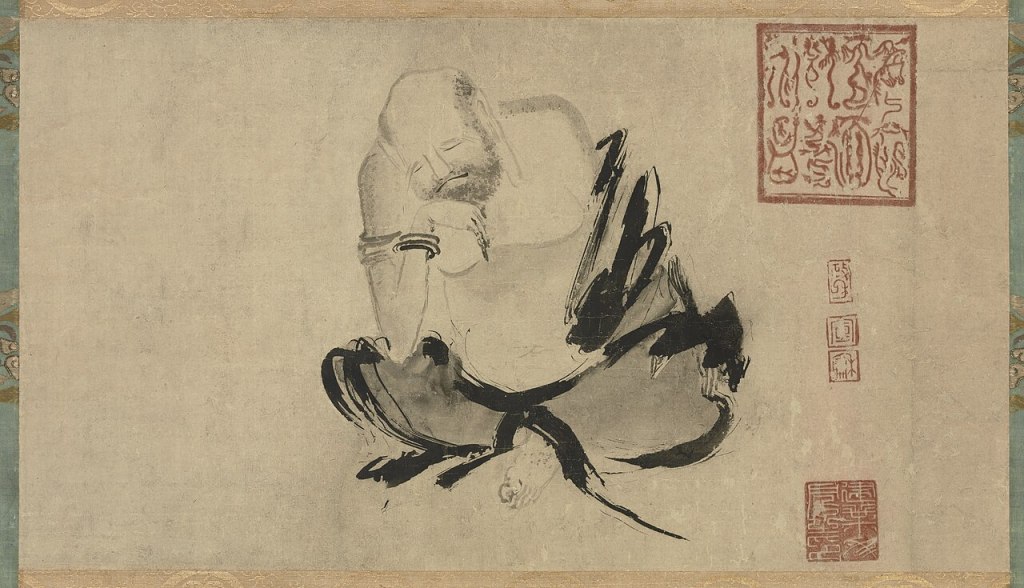
photo: zen monk Huike (慧可) thinking, by painter Shi Ke (Chinese: 石恪)


Leave a Reply