
This article is for Catholics and others who want to improve their digital wellness (personal use of the internet, technology, social media, artificial intelligence, etc.) and life wellbeing. Wellbeing or wellness is explained as having eight dimensions. Friendships are explained as important to at least three of those dimensions: the social, emotional and spiritual dimensions. Friendships, including social media versions of friendship, are explained as either contributing to digital wellness and wellbeing or limiting them. Friendships are explained as being in three basic categories: party pals, business buddies, and spiritual friends. Readers are instructed how to use personal evaluation of their friendships to improve their digital wellness by using social media for more spiritual friendships that exist and grow both online and offline. In addition, readers are instructed to put their time and effort into online and offline spiritual friendships as a way to achieve overall life wellbeing. (photo: Gary Knight, 2012)
Right now there is a lot of concern about how our use of the internet, technology, social media, and artificial intelligence is affecting our wellbeing.1 Social media use is especially a moral crisis as we see researchers debate whether screen time and social media use are brutalizing us, dividing us, and destroying our very sense of ourselves. Researchers offer conflicting evidence of whether social media use is bad for mental health.2,3,4,5,6 I think that the remaining possibility may be that it’s all about whether and how we are using the internet, technology, social media, and artificial intelligence to grow in our own wellbeing, or to be self-limiting and maybe even self-destructive in terms of digital wellness and overall life wellbeing. Luckily, there are centuries and even millennia of wisdom in the Catholic Church that has stood the test of time and that offers us a way to take take better care of our own digital wellness and life wellbeing by having better friendships.
What are digital wellness and life wellbeing?
Having good definitions of digital wellness and life wellbeing will help us understand how good friendships can help us have both of those things. Here are good definitions:
Digital Wellness
Digital wellness is a subjective individual experience of optimal balance between the benefits and drawbacks obtained from connection using mobile devices like cell phones and laptops. This experiential state is comprised of affective (feelings and emotions) and cognitive (thought) appraisals of the integration of digital connectivity into ordinary life. People experience digital well-being when they experience maximal controlled pleasure and function, together with minimal loss of control and functional impairment.7,8,9
Life Wellbeing
Life wellbeing is the individual experience of being healthy in many dimensions of one’s life, including the emotional, physical, occupational, intellectual, financial, social, environmental, and spiritual dimensions.10 These dimensions are interconnected, one dimension building on another. For example worrying about money (for example, debt or being able to afford what we need) may include the experience of anxiety (emotional), and lead to medical problems (physical), trouble at work (occupational), and possibly even to questioning our own sense of meaning and purpose (spiritual). The U.S. federal Substance Abuse and Mental Health Services Administration (SAMHSA) uses the broad term “wellness” for what I am calling life wellbeing.
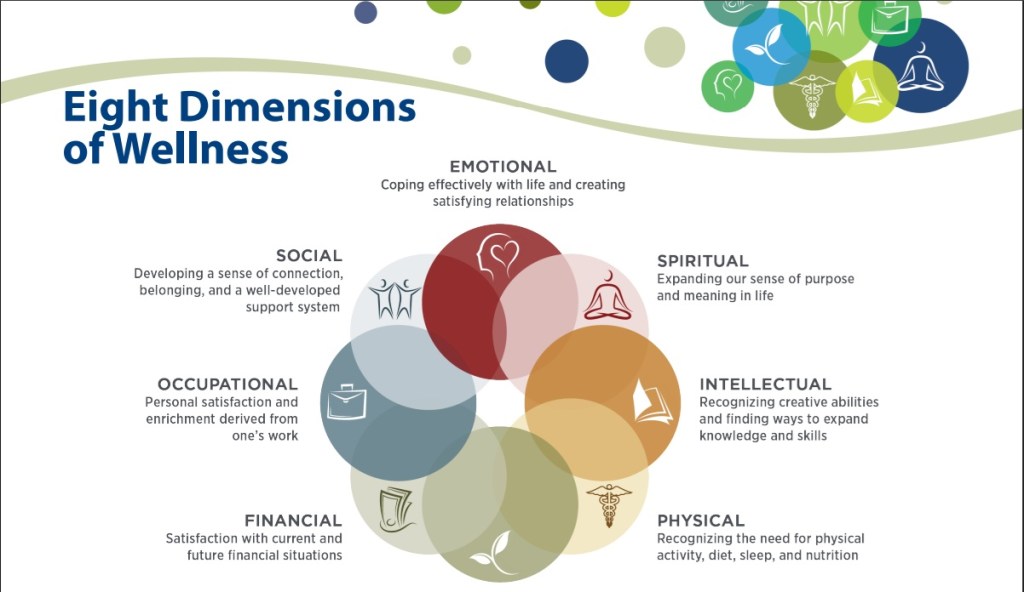
It is important to know that life wellbeing is closely related to human flourishing, which is defined as living in a state in which all aspects of a person’s life are good.11,12 I think that wellbeing and flourishing can be understood in terms of the Catechism of the Catholic Church, as the experience of participating in both the desire and fulfilment that God gives us for happiness, especially through the fulfillment of love for God and others in ways that fulfil our own potential for that kind of happiness (Matthew 22:36-40, Galatians 5:14, Catechism of the Catholic Church 1700-1729 & 1803-1811).13,14 Think of the eight dimensions of wellbeing, and then think also that you can have all of those, but if you have them without love, then you don’t really have wellbeing or flourishing (1 Corinthians 13:1-8). 15,16,17,18
How are friendships part of digital wellness and life wellbeing?
Friendships figure prominently into digital wellness and life wellbeing. That said, the picture is complicated by the wide ranging possible types, functions, elements, and connectivity of friendship. “Friend” is a very general term that can mean a lot of different things and is often used in a wide array of contexts. In the same way, “friendship” also may refer to a wide array of different kinds of relationship. Adding to the complexity are new definitions, understandings, and uses of the term “friend” that have been introduced in social media platforms. Research has studied the relationship and reality of offline friends from online friends, including friendships that exist both offline and online on social media platforms.19,20,21 For now, let’s start with a general understanding of friendship and look at how friendship is related to digital wellness and life wellbeing.
Friendships in Digital Wellness
People use cell phones, laptops and other mobile devices to connect directly with friends, and to access social media where they can also direct with friends as well as establish new friendships. Drawing from the available (and previously cited) research, I think we can reasonably concluded that users of cell phones, laptops, and other mobile devices experience digital wellness when they have:
- A balance between the benefits and drawbacks of engaging in friendships with mobile devices that is inclined more toward benefits.
- Feeling more benefit than drawbacks in using mobile device connectivity to engage in friendships, as part of ordinary life.
- Thoughtfully appraising and concluding that there are more benefits than drawbacks in using mobile device connectivity to engage in friendships, as part of ordinary life.
- Maximum personal control over the pleasure derived from using mobile device connectivity to engage in friendships.
- Maximum personal control over the functionality or usefulness of using mobile device connectivity to engage in friendships.
- Minimal loss of personal control over the pleasure derived from using mobile device connectivity to engage in friendships.
- Minimal loss of control over the functionality or usefulness of using mobile device connectivity to engage in friendships.
I think that we can say that experiencing digital wellness in friendships is essentially about:
- Deriving benefit from engaging in friendships online and with social media platforms
- Being able to control how that engagement works for and within one’s friendships
- Being able to control the pleasure derived from that engagement in friendships
I also think that we can say digital wellness is absent when a person experiences:
- Zero-benefit or actual harm from engaging in friendships online and with social media platforms, whether that lack of benefit or actual harm is experienced online or offline (i.e. offline impacts of online behavior)
- Loss of control, or struggling for control, in how online and social media friendships are functional and useful for life and wellbeing, whether online or offline (i.e. offline impacts of online behavior)
- Loss of control, or struggling for control, in how online and social media friendships provide pleasure, whether online or offline (i.e. offline impacts of online behavior)
Friendships in Life Wellbeing
I propose to you that friendship is important to all of the 8 dimensions of wellbeing {“wellness” in the depicted model) in different ways. Basically, friendship relates to the 8 dimensions of wellbeing in terms of:
- A dimension can be the focus in a life environment where friendships may be important and established, e.g. the occupational dimension of wellbeing is the focus in workplaces and schools.
- Friendships being key to growth in one or more dimensions of wellbeing, e.g. social, emotional, and spiritual dimensions of wellbeing.
A friendship may begin in one of the eight dimensions of wellbeing as that dimension happens in your life. For example, you have an occupational dimension of wellbeing related to your work and employment at a bob in a workplace. The workplace is certainly a place where a friendship can be initiated, and workplace friendships are important for both a high functioning workplace and a personal sense of safety and satisfaction.22,23

In his seminal works on spirituality, Cardinal Wyszynski even explained the importance of work for personal wellbeing, sanctity, and the establishment of the Kingdom of God.24 Any of the 8 dimensions of wellbeing may be involved in a friendship in important ways, or even a core and central element of the friendship. It is easy to imagine the same types of friendships happening in educational environments like schools, colleges and universities as well.
Friendship may also be key to personal growth in one or more of the dimensions of wellbeing. In all probability, for any person, good friendships are key to growth in the social, emotional, and spiritual dimensions of wellbeing. Good friendships can help us:
- Develop a sense of connection, belonging, and a well developed support system (social).
- Cope effectively with life and create satisfying relationships (emotional).
- Expand our sense of meaning and purpose in life (spiritual).
Of course the key word here is “good” friendships. If we want the benefits to our life wellbeing that good friendship offers, we have to know what exactly a good friendship is. Luckily, there are lireally centuries and even millennia of wisdom in the Catholic Church to help us with that.
What are the many kinds of friendship?
We could start out by saying to ourselves that there are basically two kinds of friendship for purposes of digital wellness and life wellbeing: good ones and bad ones. While that may be true, it doesn’t do a lot for helping us figure out which kinds of friendships are which, or help us understand how to work toward good friendships. There is a multiplicity of definitions of friendship around the world and the association of friendship with health and wellbeing is consistent.25 Yet, the Catechism of the Catholic Church teaches us about singular true friendship (2338 & 2347).26. Specifically a friendship that
- Is the fulfillment, “blossom,” and expression of the virtue of chastity, i.e. the personal maintenance of the integrity of the powers of life and love placed in a person.
- Teaches us how to follow and imitate Jesus Christ, who himself chose us as his friend, has given himself totally to us and allows us to participate in his divinity.
- Represents a “great good for all,” whether it is developed between persons of the same or opposite sex.
- Leads to spiritual communion.
Somewhere between the multiplicity definitions of friendship of friendship in this world, and the singular definition of friendship in the Catechism of the Catholic Church, is a definition of friendship that bridges the daily human situation and the great purpose of good for friendships — a definition that can help us with digital wellness and life wellbeing in an informed way. This is where time-tested and proven centuries and millennia of wisdom in the Catholic Church comes to our aid.
What is the best kind of friendship?
People have been thinking about the different kinds of friendship, and which kinds of friendship are true friendships for a very long time. As early as the 10th through 7th centuries B.C., the compilers of the biblical Proverbs included in their verses (Proverbs 17:17):27
A friend is a friend
at all times,
and a brother is born
for the time of adversity.
In the world of the Roman empire, the philosopher Cicero wrote the De Amicitia (“on friendship’) in the early years of the second century, B.C. Cicero famously defined friendship:28
Friendship is agreement
with kindliness and affection
about things human and divine.
In that same era, the Catholic biblical text that we know as SIrach was composed by Yeshua, son of Eleazar, son of Sira, and included an extensive consideration of how friendship works, including: (Sirach 6:14-16):29
Faithful friends are a sturdy shelter;
whoever finds one finds a treasure.
Faithful friends are beyond price,
no amount can balance their worth.
Faithful friends are life-saving medicine;
those who fear God will find them.
In the late first century A.D., the author of the gospel of John included Jesus explaining that friendship with him is based on intimate and complete knowledge (John 15:15):30,31
I no longer call you slaves,
because a slave does not know what his master is doing.
I have called you friends,
because I have told you everything I have heard
from my Father.
In the 4th century A.D., St. Gregory of Nazianzus described his exemplary friendship with St. Basil the Great in terms that were understood to represent true friendship:32
When, in the course of time, we acknowledged our friendship and recognized that our ambition was a life of true wisdom, we became everything to each other: we shared the same lodging, the same table, the same desires, the same goal. Our love for each other grew daily warmer and deeper…We seemed to be two bodies with a single spirit. Though we cannot believe those who claim that everything is contained in everything, yet you must believe that in our case each of us was in the other and with the other.
In the late 4th century A.D. and early 5th century, St. Augustine completed his two seminal works the Confessions and the City of God. Both of these great works includes St. Augustine’s thoughts on true and best friendship, especially as a response to the social nature in us that is purposed for the Kingdom of God. In the Confessions, St. Augustine explained that true friendship consists of loving God in your friend and the friendship being a participation in God’s love:33
You only love your friend truly, after all,
when you love God in your friend,
either because he is in him,
or in order that he may be in him.
That is true love and respect.
There is no true friendship unless you weld it
between souls that cling together
by the charity poured forth in their hearts
by the Holy Spirit.
There are some common elements running through these explanations of true friendship, from the earliest sources in the 5th century B.C. to sources in 5th century A.D. I would summarize these common elements as:
- Friends engage in real care for each other, with love and respect.
- Friends agree on the most important things in life and aspire to those same things.
- Friends share their experiences with each other and know each other intimately.
- Friends are loyal and especially aid and comfort each other when life is hard = As St. Augustine said, “There is no greater consolation than the unfeigned loyalty and mutual affection of good and true friends.”34
- Friends are both a reflection of God’s love and friendship and are God’s love and friendship in action.
We can think about these common elements as a way to start looking at things we call “friendships” and evaluate if they really do stack up in terms of these common elements. If we do that, we might see some friendships as truly wonderful in their depth, quality, and rarity. We may also see that one or another of what we have called “friendships” may at best be a friendship in the process of development, and at worse, no kind of friendship at all and not going to be one anytime soon.
How can Aelred of Riveaulx help us sort our friendships?
Sorting friendships so that good ones could be seen apart from the ones that are unhelpful for spiritual growth was an important concern of a 12th century abbot in England known as Aelred of Rieveaulx. He had a unique vantage point to speak on the topic because he had been a favorite courtier of King David I of Scotland for a large part of his life, and later entered the Cistercian order in which he became abbot of one of England’s most important monasteries. During his lifetime, Aelred of Riveaulx had seen and learned the importance of friendships in the life of worldly society and politics, as well as in the life of enclosed communities dedicated to functioning both as religious centers of devotion and practice, as well as centers of knowledge and education. He was also well-versed in at least most of the earlier sources of advice on friendship that we have reviewed. Aelred wrote down his insights in a work entitled simply as De Spirituali Amicitia (On Spiritual Friendship), and it is the most compact and easily understandable work, drawn from centuries of wisdom as well as practical observations, that we can use to have and see real friendships in our lives.35
Aeled of Riveaulx saw that there are three basic kinds of friendship:
- Friends who like the same pleasures in life — for fun let’s call them “party pals.”
- Friends who who collaborate to be successful in worldly ways — let’s call them “business buddies.”
- Friends who align their shared friendship with Jesus Christ and the Gospel — let’s call them what Aelred of Riveaulx called them, “spiritual friends.”
Three basic categories: party pals, business buddies, and spiritual friends.

Aelred of Riveaulx saw party pals as friendships based on what gives pleasure in life and a mutual commitment to prioritizing those things, going after them, and supporting each other in continuing to prioritize and chase after experiences of “good times.” We may hear someone say that their friendship is based on “We like the same things!” and understand that when the “things” are just entertainments, the friendship is in danger of just being a partnership in pursuit of a good feeling, and that’s it. Understandably, Aelred of Riveaulx was very critical of party pal friendships as shallow and even as derailing and destructive for people. Add in that a party pal may continually encourage and enable a shallow, derailing, and destructive friendship, and you have a real problem. Party pal friendships are still with us today. Sometimes they are obvious by their external and visible scenes and appearances, but they can also be hidden or dressed up as another kind of friendship. It can sometimes take hard and honest discernment to realize a friendship is just a party pal arrangement.
Business buddies have a friendship that functions as a partnership in pursuing success in the world through achievement and attainment. The friendship includes supporting each other in that pursuit, including through challenges and the negotiation of obstacles. Aelred of Riveaulx took a less critical view of business buddies, perhaps because the achievements and attainments of business can be about the achievement and attainment of things that are good. In addition, unlike party pals, business buddies include hardship and struggle not as something to be avoided, but as something to be accepted and undertaken as part of their pursuit. Aelred of Riveaulx even suggested that business buddies could, in time and with some intentionality, become spiritual friends. In our modern world, we may have business buddies that we know as classmates, study partners, coworkers. colleagues, or business partners.
When it comes to the third category, that of spiritual friends, Aelred of Riveaulx revives Cicero’s definition of friendship as “agreement with kindliness and affection about things human and divine.” He further clarifies that spiritual friendship is about this agreement showing up in the “likeness of life, habits, and interests” between two friends. It’s an agreement so profound that Aelred explains, “For the friend will rejoice with my soul rejoicing, grieve with it grieving, and feel that everything that belongs to a friend belongs to himself.” Aelred’s words may remind you of St. Gregory of Nazianzen’s earlier words, “each of us was in the other and with the other.” Most importantly, Aelred explained that spiritual friendship is the right kind of friendship, and finds its origins, continuance, and perfection in Jesus Christ:
The right kind of friendship
should begin in Christ,
be maintained according to Christ,
and have its end and value referred to Christ:
Christ, who is the beginning and end of friendship.
Now we can apply Aelred of Riveaulx’s wisdom to our own digital wellness and overall life wellbeing.
How to Improve Your Digital Wellness and Wellbeing with Better Real-Life Friendships
Now that we have picked up some wisdom from Aelred of Riveaulx’s we can use it to do a few things to improve our digital wellness and overall life wellbeing. Here’s the list!
7 Ways to Improve Digital Wellness & Wellbeing with Better Friendships
- Take an honest look at our current friendships, see which ones are truly enduring spiritual friendships, and prioritize them.
- Take an honest look at how we “do” friendship, and whether it is helping us have spiritual friendships in our life or wasting our time and energy on poor quality friendships — especially in our use of social media.
- Stop hanging out with people, and in places, where spiritual friendship is not the goal or valued, and start hanging out with people who have a goal of spiritual friendship and value it — especially in our use of social media.
- Build new friendships, maybe even out of old ones, that are Christocentric, intimate, and enduriing in the way that Aelred of Riveaulx recommends as “the right friendship.”
- Always take yourself seriously and insist on friendships for yourself that are at least headed toward spiritual friendship — and don’t compromise!
- Add your personal prayers for better friendships, digital wellness, and life wellbeing to your daily practices of spirituality. If you don’t have daily practices of prayer and spirituality, start them.
- Talk online and offline about good friendships with your friends, including spiritual friendship, and explain that you have decided to make that important in your life. They will understand you better or clearly be disinterested, and some friends will think about making it a priority in their life as well.
What is the right way for you to use social media?
In the “7 Ways” list, you’ll notice that I push hard on social media use and getting it cleaned up. I am convinced that social media in fact can be a good tool to engage in good, true, and spiritual friendships when you can’t be with a person. I am not pushing the now tired old message that all social media and all use of social media is going to automatically make you compulsive, anxious, and depressed. But also see clearly that good use of social media, in ways that will build your digital wellness, requires some very honest looks at what we’re using social media for, who we’re using social media for, why we’re using social media, how we’re using social media, and whether it is actually supporting our spiritual friendships. If we’re not usng it for spiritual friendships, we’re not using it in a way that supports our digital wellness, or our overall life wellbeing.
Let’s be clear, having a hundred so-called “friends” and friendships on social media of very poor quality is a bad situation. It is better to have a much smaller number of real spiritual friends who exist as your spiritual friends offline and use social media for connection in between times of being together. It will always require us to be attentive to our friendships, honest with ourselves about them, and ready to discard the friendships that are not good for our digital wellness and overall life wellbeing.
Is staying off social media a good idea for you?
There is a quiet possibility: giving up and not using social media. Not even using social media is its own possibility for you. No matter what you have been caused to think or feel about it, you don’t need it, and you might be better off without it de[ending on the quality of friendships you are engaging in with it and how you are using it to engage. That possibility just has to be on the table too. Spiritual friendship does not depend on social media and does perfectly fine without it. Missing a true and good spiritual friend is one of life’s bittersweet experiences that actually makes our lives more full, and makes us better at being human. The joy of reuniting with a true and good spiritual friend is just as important for us to experience.
How does parenting with better friendships, digital wellness, and wellbeing work?
If you are a parent to a young person, there is an added layer to all of this. As a parent, the quality of your friendships, and how you engage in those friendships, sets an example to your child. When you have high-quality friendships, true and good spiritual friends, your child will see and learn from you that friendships are supposed to be spiritual friendships. You child will see the things that spiritual friends do and say, and especially how they treat each other with deep care and loyalty. If you’re not doing spiritual friendships, your child will learn elsewise and sadly may not even know the difference.
With regard to digital wellness, it is probable that your child is observing you as an example with regard to screen time and social media use. Some parents have used a portable electronic device as a way to occupy and entertain their children — and I’m not saying that’s wrong all of the time. What I am saying is that it is important to always consider “What am I teaching my child about healthy use of technology, phones, screens, media?” in each interaction with your child where one or more of these is involved. Parenting is hard ork and it’s easy to become too busy to think about it, but it’s very important and may have lifelong consequences for your child. Parenting is tough because “It’s not about you anymore.” But what if you could improve your own digital wellness and life wellbeing and your child’s at the same time?
You can take the steps listed above in the “7 Ways” list and improve your own digital wellness and overall life wellbeing. The good news is that when you do that, your child will see you doing that and again regard you as the example. In that way, you both benefit from using the “7 Ways” to improve digital wellness and life wellbeing. Potentially, you will each be happier individually, and happier together in your family.
Can prayer help with better friendships, digital wellness, and life wellbeing?
The potential of prayer for improving your friendships, digital wellness, and wellbeing cannot be overstated. Spirituality itself is a component of wellbeing, so just by praying you are engaging in a practice that will improve your wellbeing. We know from the Gospel of John that Jesus declared “I came so that they might have life and have it more abundantly” (John 10:10).36 When you are praying for better friendships, digital wellness, and life wellbeing for yourself, you are praying for a more abundant life. The words of our Savior make very clear that God wants you to have those things — you are not asking for something that God will not give you. Pray with confidence.
There are not right or wrong words to use because God already knows what is in your heart (Matthew 6:8).37 In important ways, and especially with an understanding of what is meant by the phrase “daily bread” as that which gives you nourishment and life, the Lord’s Prayer is probably a very good way to pray for better friendships, digital wellness, and life wellbeing. You could also just sit quietly with an openness to God in your mind along with a desire and intention that God enter your life and your heart more fully, including help with better friendships, digital wellness, and life wellbeing. Our Lord and Savior wants to get to you, and you don’t need to worry about sending the perfect invitation.
What is the most important thing for you to know about friendships, digital wellness, and life wellbeing?
The most important thing for you to know about friendships, digital wellness, and life wellbeing is that:
- Wellbeing depends on good friendships, and good friendships depend upon Jesus Christ.
- Digital wellness is using technology and devices in ways that support life wellbeing, and that includes having high-quality friendships.
- Wellbeing is a multidimensional thing, involving different arts of our life, and yet making us a single whole person.
- In a multidimensional model of wellbeing, high-quality friendships support your spirituality, and your spirituality supports high-quality friendships.
- The highest quality friendship that you can have is the spiritual friendship explained by Aelred of Riveaulx and over a millenia of authors before him.
- You can choose the friendships in your life, and how you engage with them, in ways so that you have spiritual friendships, digital wellness, and life wellbeing.
Please share these words with someone who needs them today.
This article is an original work of the author and was not composed by or with artificial intelligence (AI). The author is solely responsible for the contents of this article. © 2026 Thomas Delaney. All rights reserved.
NOTES
- Thomas, N. M., Choudhari, S. G., Gaidhane, A. M., & Quazi Syed, Z. (2022). ‘Digital wellbeing’: The need of the hour in today’s digitalized and technology driven world! Cureus, 14(8), e27743. https://doi.org/10.7759/cureus.27743
- Ferguson, C. J., Kaye, L. K., Branley-Bell, D., & Markey, P. (2025). There is no evidence that time spent on social media is correlated with adolescent mental health problems: Findings from a meta-analysis. Professional Psychology: Research and Practice, 56(1), 73–83. https://doi.org/10.1037/pro0000589
- Vasconcellos, R. P., Sanders, T., Lonsdale, C., Parker, P. D., Conigrave, J., Tang, S., del Pozo Cruz, B., Biddle, S. J. H., Taylor, R., Innes-Hughes, C., Salmela-Aro, K., Vasconcellos, D., Wilhite, K., Tremaine, E., Booker, B., & Noetel, M. (2025). Electronic screen use and children’s socio-emotional problems: A systematic review and meta-analysis of longitudinal studies. Psychological Bulletin, 151(5), 513–543. https://doi.org/10.1037/bul0000468
- Zablotsky B, Ng AE, Black LI, Haile G, Bose J, Jones JR, et al. Associations Between Screen Time Use and Health Outcomes Among US Teenagers. Prev Chronic Dis 2025;22:240537. DOI: http://dx.doi.org/10.5888/pcd22.240537
- Nakshine VS, Thute P, Khatib MN, Sarkar B. Increased Screen Time as a Cause of Declining Physical, Psychological Health, and Sleep Patterns: A Literary Review. Cureus. 2022 Oct 8;14(10):e30051. https://doi: 10.7759/cureus.30051. PMID: 36381869; PMCID: PMC9638701.
- Silva Santos, R. M., Ventura, S. d. A., Nogueira, Y. J. d. A., Mendes, C. G., Jardim de Paula, J., Marques Miranda, D., & Romano-Silva, M. A. (2024). The associations between screen time and mental health in adults: A systematic review. Journal of Technology in Behavioral Science, 9(4), 825–845. https://doi.org/10.1007/s41347-024-00398-7
- Mariek M P Vanden Abeele (2021). Digital Wellbeing as a Dynamic Construct, Communication Theory, Volume 31, Issue 4, November 2021, Pages 932–955, https://doi.org/10.1093/ct/qtaa024
- Vanden Abeele, M. M. P., & Nguyen, M. H. (2022). Digital well-being in an age of mobile connectivity: An introduction to the Special Issue. Mobile Media & Communication, 10(2), 174–189. https://doi.org/10.1177/20501579221080899
- Uslu, O. Understanding digital wellbeing: impacts, strategies, and the path to healthier technology practices. Discov Soc Sci Health 5, 145 (2025). https://doi.org/10.1007/s44155-025-00259-5
- Substance Abuse and Mental Health Services Administration. (2016). Creating a healthier life: A step-by-step guide to wellness (SMA 16-4958). U.S. Department of Health and Human Services. https://library.samhsa.gov/sites/default/files/sma16-4958.pdf
- VanderWeele TJ. On the promotion of human flourishing. Proc Natl Acad Sci U S A. 2017 Aug 1;114(31):8148-8156. doi: 10.1073/pnas.1702996114. Epub 2017 Jul 13. PMID: 28705870; PMCID: PMC5547610. https://doi.org/10.1073/1702996114
- Höltge, J., Cowden, R. G., Lee, M. T., Bechara, A. O., Joynt, S., Kamble, S., Khalanskyi, V. V., Shtanko, L., Kurniati, N. M. T., Tymchenko, S., Voytenko, V., McNeely, E., & VanderWeele, T. J. (2023). A systems perspective on human flourishing: Exploring cross‑country similarities and differences of a multisystemic flourishing network. The Journal of Positive Psychology, 18(5), 695–710. https://doi.org/10.1080/17439760.2022.2093784
- See Matthew 22:36-40 and Galatians 5:14 in United States Conference of Catholic Bishops. (n.d.). New American Bible, Revised Edition. USCCB. https://bible.usccb.org/.
- See 1700-1729 and 1803-1811 in United States Conference of Catholic Bishops. (n.d.). Catechism of the Catholic Church. USCCB. https://www.usccb.org/catechism.
- See 1 Corinthians 13:1-8 in in United States Conference of Catholic Bishops. (n.d.). New American Bible, Revised Edition. USCCB. https://bible.usccb.org/.
- VanderWeele, T. J. (2023). On an analytic definition of love. Journal of Ethics and Social Philosophy, 25(1), 105–135. https://doi.org/10.26556/jesp.v25i1.2695
- VanderWeele, T. J., & Lee, M. T. (2025). Love and human flourishing. International Journal of Wellbeing, 15(4). https://doi.org/10.5502/ijw.v15i4.4663
- VanderWeele, T. J. (2025, October 29). How love helps us flourish. Psychology Today. https://www.psychologytoday.com/us/blog/human-flourishing/202510/how-love-helps-us-flourish
- Helliwell JF, Huang H. Comparing the happiness effects of real and on-line friends. PLoS One. 2013 Sep 3;8(9):e72754. doi: 10.1371/journal.pone.0072754. PMID: 24019875; PMCID: PMC3760892. https://doi.org/10.1371/0072754
- Steinsbekk S, Bjørklund O, Valkenburg P, Nesi J, Wichstrøm L. The new social landscape: Relationships among social media use, social skills, and offline friendships from age 10-18 years. Comput Human Behav. 2024 Jul;156:108235. doi: 10.1016/j.chb.2024.108235. Epub 2024 Apr 5. PMID: 39513051; PMCID: PMC11540422. https://doi.org/10.1016/j.chb.2024.108235
- Lieberman, A., & Schroeder, J. (2020). Two social lives: How differences between online and offline interaction influence social outcomes. Current Opinion in Psychology, 31, 16–21. https://doi.org/10.1016/j.copsyc.2019.06.022
- Fasbender, U., Burmeister, A., & Wang, M. (2023). Managing the risks and side effects of workplace friendships: The moderating role of workplace friendship self-efficacy. Journal of Vocational Behavior, 143, 103875. https://doi.org/10.1016/j.jvb.2023.103875
- Durrah, O. (2022).Do we need friendship in the workplace? The effect on innovative behavior and mediating role of psychological safety.Current Psychology, 41(11), 1–14. https://doi.org/10.1007/s12144-022-03949-4 PMCID: PMC9645324
- Wyszyński, S. C. (1998). Working your way into heaven: How to make work, stress, and drudgery a means to your sanctity. Sophia Institute Press.
- Lu, P., Oh, J., Leahy, K. E., & Chopik, W. J. (2021). Friendship importance around the world: Links to cultural factors, health, and well-being. Frontiers in Psychology, 11, Article 570839. https://doi.org/10.3389/fpsyg.2020.570839
- See 2338 and 2347 in United States Conference of Catholic Bishops. (n.d.). Catechism of the Catholic Church. USCCB. https://www.usccb.org/catechism.
- See Proverbs 17:17 in United States Conference of Catholic Bishops. (n.d.). New American Bible, Revised Edition. USCCB. https://bible.usccb.org/.
- Peabody, A. P. (Trans.). (1901). Laelius de amicitia (On friendship). Portland, ME: Thomas B. Mosher. https://dn790008.ca.archive.org/0/items/deamicitia00ciceuoft/deamicitia00ciceuoft.pdf
- See Sirach 6:14-16 in United States Conference of Catholic Bishops. (n.d.). New American Bible, Revised Edition. USCCB. https://bible.usccb.org/.
- See John 15:15 in United States Conference of Catholic Bishops. (n.d.). New American Bible, Revised Edition. USCCB. https://bible.usccb.org/.
- Leo XIV, Pope. (2026, January 14). General audience: Catechesis on the documents of Vatican Council II — Dogmatic Constitution Dei Verbum, 1. God speaks to men as to friends (Audience Hall, Wednesday, 14 January 2026). Vatican.va. The Holy See. https://www.vatican.va/content/leo-xiv/en/audiences/2026/documents/20260114-udienza-generale.html
- Gregory of Nazianzus, St. (n.d.). Oratio 43: In laudem Basilii Magni (¶¶ 15, 16–17, 19–21). In J.-P. Migne (Ed.), Patrologiae cursus completus, series graeca (Vol. 36, cols. 514–523). Paris: J.-P. Migne.
- Augustine of Hippo, St. (1961). Confessions (R. S. Pine-Coffin, Trans.). Penguin Classics.
- Augustine of Hippo, St. (2003). The city of God (H. Bettenson, Trans.; G. R. Evans, Intro.). Penguin Classics.
- Aelred of Rievaulx, St. (2010). Spiritual friendship (M. L. Dutton, Ed.; L. C. Braceland, Trans.). Cistercian Publications.
- See John 10:10 in United States Conference of Catholic Bishops. (n.d.). New American Bible, Revised Edition. USCCB. https://bible.usccb.org/.
- See Matthew 6:8 in United States Conference of Catholic Bishops. (n.d.). New American Bible, Revised Edition. USCCB. https://bible.usccb.org/.
This article is for educational and faith formation purposes only and is not a substitute for professional mental health care. If you need professional help, or are in crisis, call or send a text to 988 to get connected with a professional.
If your parish or faith community is seeking a deeper experience of wellbeing, forgiveness, inner renewal and spiritual growth, Live and Forgive is here to help. To begin the conversation, email Live and Forgive presenter and facilitator Tom Delaney at tom@liveandforgive.com — he will be glad to connect with you for a conversation.
Please type in your email and click “Subscribe” below to stay connected and get Live and Forgive articles delivered to you.
Take your learning deeper! Enter the term or word for any idea or thing you saw in this article that you want to know more about, and you will get a list of other articles that also talk about that idea or thing!
 Live and Forgive
Pingback: School Cell Phone & Social Media Limits Confirm the Friendship & Digital Wellbeing Connection | Live and Forgive